You’ve moved plants indoors: Now What?
K-State horticulture expert shares tips for maintaining growth during the cold months
At a glance: K-State horticulture expert Cynthia Domenghini shares tips on how to help cold-sensitive plants survive their new indoor environment this winter.
More information: Cynthia Domenghini, Cdom@ksu.edu
Related: K-State Horticulture Newsletter
Oct. 24, 2024
By Pat Melgares, K-State Research and Extension news service
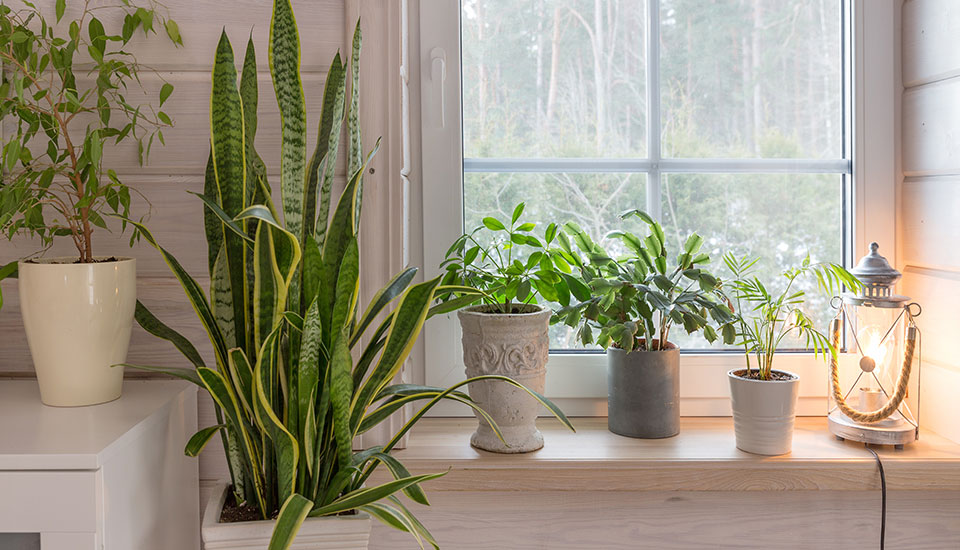
Indoor plants should receive bright, indirect light either from a window or grow lights, says K-State horticulture expert Cynthia Domenghini.
MANHATTAN, Kan. – Cold temperatures have come to Kansas in bits and spurts this year, but enough so that many gardeners have moved cold-sensitive plants indoors recently.
It begs the question: Now what?
“Hopefully, you were able to transition your plants to the indoors (by gradually introducing them to less light), but if not, they may go through a period of shock,” said Kansas State University horticulture expert Cynthia Domenghini.
Symptoms of shock may include yellowing leaves, dieback and wilt, she said.
“Some plants won’t survive the shock if it’s extreme,” Domenghini said. “Others will recover over time and with proper care.”
Domenghini offers tips for helping plants survive their new indoor environment.
Water and fertilizer
Whether indoors or out, the amount of light decreases from fall to winter, resulting in slower plant growth. “This means the fertilizer and water needs will decrease,” Domenghini said.
She suggests only providing water when the soil is dry about one-inch deep. Fertilizer can be applied at one-fourth the recommended rate in November, then again in February.
“Plants in smaller containers often require water more frequently, but less fertilizer because they have less soil,” Domenghini said. “This varies based on species, so do your homework and research individual plant needs.”
Temperature
If the air temperature drops below 50 degrees Fahrenheit, the leaves of more sensitive plants may begin to yellow. “Keep this in mind if you adjust the thermostat during times when nobody is home, such as vacations,” Domenghini said.
Humidity
When the humidity is lower, plants release more water from the leaves. Many common indoor plants prefer high relative humidity.
“To increase the relative humidity, you can create a micro-climate by grouping plants closer together,” Domenghini said. “Another option is to place a shallow container below each plant and fill it with water. Elevate the container by placing some gravel in the saucer so that the plant isn’t soaking directly in the water.”
Misting plant leaves is recommended by some, but Domenghini says it is not a practical strategy to effectively increase humidity.
Light
Indoor plants should receive bright, indirect light either from a window or grow lights. Avoid placing plants too close to windows that are drafty, or next to heat vents.
Some indicators that plants are not receiving enough light include:
- Elongated internodes (space between leaf/stem unions).
- Pale foliage color on new leaves.
- Dieback of older leaves.
Domenghini and her colleagues in K-State’s Department of Horticulture and Natural Resources produce a weekly Horticulture Newsletter with tips for maintaining home landscapes and gardens.
Interested persons can subscribe to the newsletter, as well as send their garden and yard-related questions to hortsupport@ksu.edu, or contact your local K-State Research and Extension office.
# # #
Sidebar: Question of the Week
My lawn is being littered with acorns and I cannot keep up with gathering them. Is there a way to prevent my tree from dropping so many acorns?
Similar versions of this question come through for various tree species, related to the mess they make. Our first point is to pay careful attention to the details of plant growth and fruiting habits when you first select landscape trees. Choose trees and place them appropriately in the landscape to avoid these issues.
In theory, there are products that can make acorns abort before they enlarge, but the timing is critical and very difficult to achieve with consistency. The efficacy of these products will also vary from one species to another, since the fruiting habit differs. The investment, usually, is not worthwhile.
Rest assured, cleaning up all the acorns in the lawn and landscape is not a required task since squirrels and other animals usually will do the job for you. Some tools available to assist with gathering acorns include a garden rake and lawn vacuum.
 -- Cynthia Domenghini, K-State horticulture expert, Cdom@ksu.edu

K‑State Research and Extension is a short name for the Kansas State University Agricultural Experiment Station and Cooperative Extension Service, a program designed to generate and distribute useful knowledge for the well‑being of Kansans. Supported by county, state, federal and private funds, the program has county extension offices, experiment fields, area extension offices and regional research centers statewide. Its headquarters is on the K‑State campus in Manhattan. For more information, visit www.ksre.ksu.edu. K-State Research and Extension is an equal opportunity provider and employer.