Should you save trees damaged by storms?
K-State horticulture expert says not all trees should be salvaged
At a glance: K-State horticulture expert Cynthia Domenghini shares management tips for homeowners whose trees were damaged by recent storms.
More information: Cynthia Domenghini, Cdom@ksu.edu
Related: K-State Horticulture Newsletter
May 1, 2025
By Pat Melgares, K-State Research and Extension news service
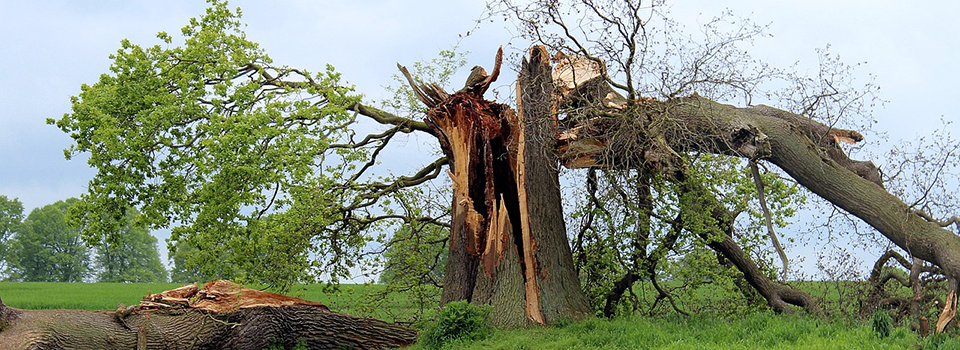
Storm-damaged trees with bark that has split and exposed the cambium or those where the main trunk has split are not likely to survive.
MANHATTAN, Kan. – A Kansas State University horticulture expert says not all trees should be salvaged if they were damaged by storms and heavy winds that hit parts of Kansas in late April.
Cynthia Domenghini said landowners should evaluate trees to determine if the bark has been split, exposing the cambium, or those where the main trunk has split.
“These trees are not likely to survive,” Domenghini said. “Trees with so many broken limbs that the structure is altered also may best be replaced.”
Damaged trees may put on new growth, but Domenghini notes that they are under such extreme stress that they are much more susceptible to diseases and pests, and can be dangerous due to increased risk for further breaks.
For trees with less damage, Domenghini offers tips to help them heal:
- Prune broken branches to the next larger branch or the trunk. Do not cut flush with the trunk, but rather to the collar area between the branch and the trunk. “Cutting flush to the trunk creates a larger wound that takes longer to heal,” she said.
- Cut back large limbs progressively. The first cut should be made on the underside of the branch about 15 inches away from the trunk. Cut about one-third of the way through the limb. The second cut should be made on top of the branch, but about two inches further away from the trunk, creating an angle when joined with the first cut. A third cut should be made at the collar, to remove the resulting stub.
Additional help and information may be available at local extension offices in Kansas.
Planting warm season vegetables
Warmer temperatures in Kansas mean it’s time for gardeners to begin planting warm-season vegetables. There are exceptions, however.
“Winter squash and pumpkin should be delayed until mid- to late June,” Domenghini said. “The first generation of squash bugs is active in July. Delaying the planting date for squash will result in younger plants that can escape this round of squash bug damage. Plants will need protection from the second generation of squash bugs, which is present in August.”
More information on squash bugs is available online from the K-State Research and Extension bookstore.
Domenghini reminded gardeners that young plants need protection from the wind. “As you move seedlings into the garden, remember to harden them off by exposing them to the elements gradually,” she said.
“In small scale gardens you can also create a windbreak to protect young transplants, but this is not practical on a large scale.”
Tomatoes can be transplanted when the soil temperature is 55 degrees Fahrenheit. Peppers, cucumbers, melons and squash should be planted when the soil temperature is at least 60 F.
“Our soil temperature in Kansas is high enough now that it is safe to plant most warm-season crops,” Domenghini said.
Domenghini and her colleagues in K-State’s Department of Horticulture and Natural Resources produce a weekly Horticulture Newsletter with tips for maintaining home landscapes and gardens.
Interested persons can subscribe to the newsletter, as well as send their garden and yard-related questions to hortsupport@ksu.edu, or contact your local K-State Research and Extension office.
Question of the Week
I was at the park yesterday and saw these little bugs crawling all over the place. What are they?
These are the larvae of ladybird beetles, more often referred to as ladybugs. Adult and larvae of the ladybird beetle are beneficial insects. They feed on pests such as aphids, mealybugs, whiteflies and scale, and do not harm garden plants. The larvae may look menacing, with the orange and black markings on their bodies, but they are effective at managing garden pests.
 -- Cynthia Domenghini, K-State horticulture expert, Cdom@ksu.edu
***

K‑State Research and Extension is a short name for the Kansas State University Agricultural Experiment Station and Cooperative Extension Service, a program designed to generate and distribute useful knowledge for the well‑being of Kansans. Supported by county, state, federal and private funds, the program has county extension offices, experiment fields, area extension offices and regional research centers statewide. Its headquarters is on the K‑State campus in Manhattan. For more information, visit www.ksre.ksu.edu. K-State Research and Extension is an equal opportunity provider and employer.