Cattle Chat: What producers can do to cut down bull conflict
K-State beef cattle experts suggest several ways producers may want to consider housing bulls for minimal fighting
At a glance: K-State experts from the Beef Cattle Institute share practical strategies—like providing more space, smarter pen design and thoughtful bull grouping to help producers reduce aggression and improve safety when housing bulls together.
More information:
Bob Larson, 785-532-5700, rlarson@vet.k-state.edu
Brad White, 785-532-4243, bwhite@vet.k-state.edu
Phillip Lancaster, 785-564-7462, palancaster@vet.k-state.edu
Related: Beef Cattle Institute Cattle Chat podcast
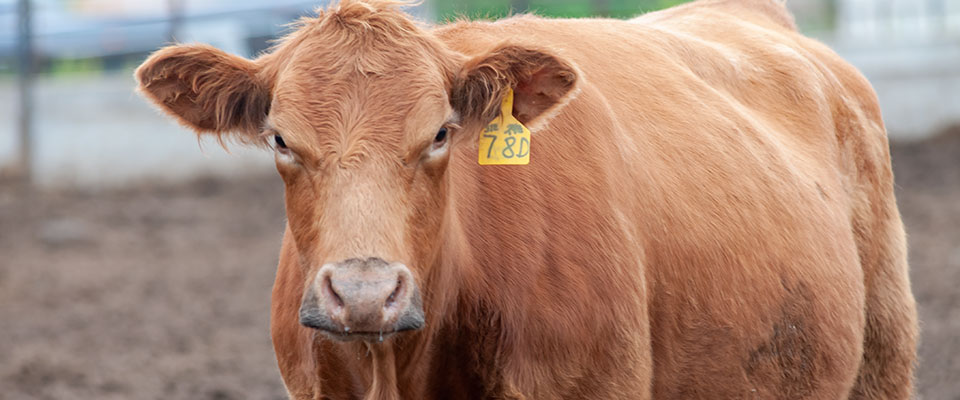
To reduce conflicts between bulls, K-State Beef Cattle Institute experts suggest making pens larger than one thinks they need to be.
Nov. 18, 2025
By Chevy-Lynn Vaske, K-State Extension news service
MANHATTAN, Kan. — Anyone who’s ever had a difficult roommate knows the struggle of sharing space — and according to Kansas State University beef experts, bulls aren’t much different.
On a recent BCI Cattle Chat podcast episode, K-State beef cattle experts discussed what producers can do to reduce conflict when co-mingling bulls.
“We really don’t have strong data that tells us the exact ‘right’ way to co-mingle bulls,” K-State veterinarian Bob Larson said. “But we do know the basics matter: Plenty of space, plenty of water and plenty of feed go a long way toward reducing aggressive behavior.”
Larson emphasized that pen and housing design is where producers have the greatest opportunity to prevent injuries.
“Pen design is probably where we have the most room for problems,” he said. “Make the pen bigger than you think it needs to be. Giving bulls extra space doesn’t solve everything, but it absolutely helps.”
BCI beef cattle nutritionist Phillip Lancaster also weighed in, noting that physical barriers can make a difference under the right conditions. “If you have the facilities, separating bulls with a solid fence can prevent a lot of fighting,” Lancaster said.
The experts also discussed how bull age and maturity levels can influence behavior. According to Larson, mixing bulls of different ages may actually reduce conflict.
“A yearling bull paired with a mature bull may have fewer problems because everyone knows their place a little better,” he said. “Hierarchy gets sorted out more quickly when the size and maturity differences are obvious.”
While no management strategy can eliminate all fighting, Larson said thoughtful planning can reduce both the frequency and intensity of conflict.
“You probably can’t prevent every fight, but you can create an environment that lowers the risk,” Larson said. “Space, resources and smart grouping decisions give you the best odds of success.”
The veterinarians ultimately concluded there is not significant research to justify if any of these methods are considered effective, but these are just suggestions. To learn more about this topic, as well as information about rural veterinary clinics and bull-to-cow ratios, check out the BCI Cattle Chat podcast.
Questions on these topics also can be sent by email, bci@ksu.edu.
***

K‑State Extension is a short name for the Kansas State University Cooperative Extension Service, a program designed to generate and distribute useful knowledge for the wellbeing of Kansans. Supported by county, state, federal and private funds, the program has county extension offices statewide. Its headquarters is on the K‑State campus in Manhattan. For more information, visit www.ksre.ksu.edu. K-State Extension is an equal opportunity provider and employer.