In the Garden: Now is the time to harvest horseradish
Horseradish spreads quickly, so harvesting it each year is important
At a glance: K-State horticulture expert Cynthia Domenghini shares tips for harvesting horseradish in November.
More information: Cynthia domenghini, hortsupport@ksu.edu
Related: Horticulture Newsletter
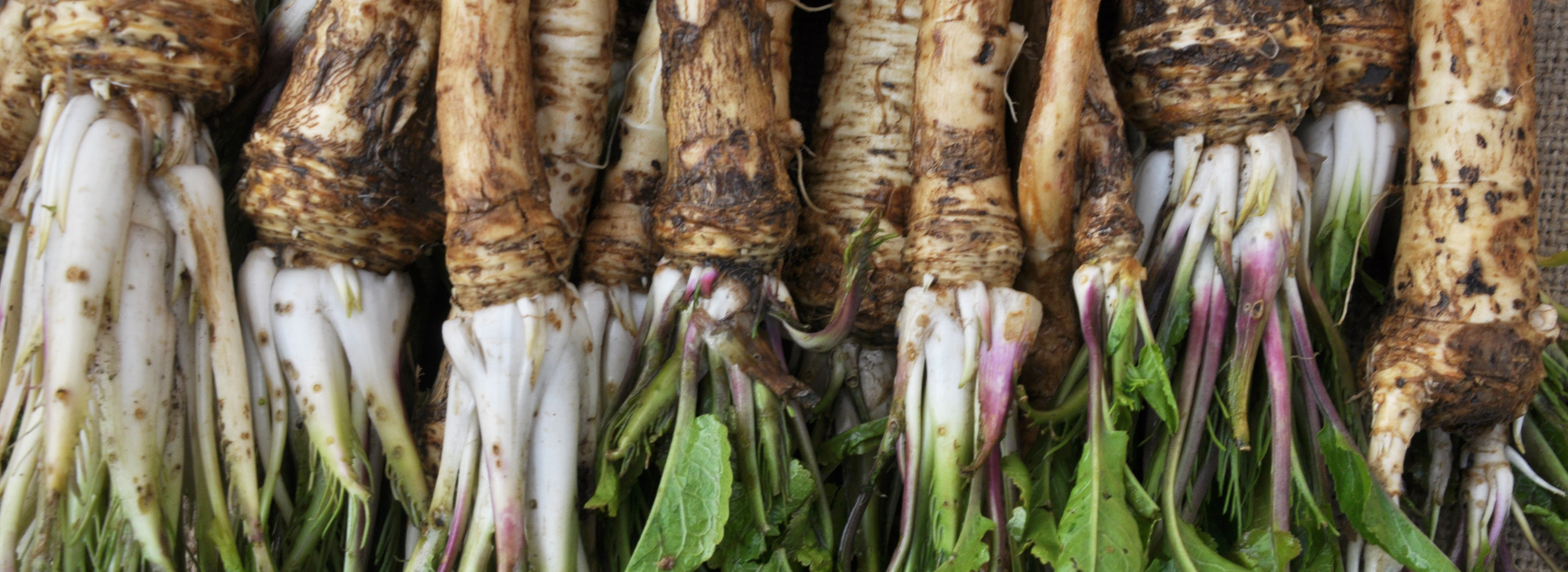
Horseradish should be harvested just before the ground freezes in November.
Nov. 11, 2025
K-State Extension news service
MANHATTAN, Kan. — A Kansas State University horticulture expert says gardeners should be keeping close watch on the weather before harvesting a root vegetable that packs quite the bite.
Cynthia Domenghini said horseradish grows a substantial amount at the end of summer and early fall, but harvest should be delayed until just before the ground freezes in November or December. Domenghini said horseradish is a perennial plant, but is most commonly grown as an annual and harvested when the leaves have died back from frost.
“To harvest horseradish, dig a trench alongside the row of plants exposing the roots. Use a shovel or pull the plants by hand toward the trench releasing them from the soil,” Domenghini said.
Next, she said, remove the foliage, leaving about one inch above the crown and remove smaller, side roots. Collect the larger roots for storage. Domenghini said smaller roots can be cut into 6-8 inch long sections and planted now for next year’s crop.
“You may choose to leave horseradish roots in the ground until spring,” Domenghini said. “Apply a thick layer of mulch to prevent the ground from freezing and harvest as needed.”
Domenghini warned that horseradish can easily spread throughout the garden if not contained, so harvesting it each year is important.
After harvesting, wash the roots thoroughly and dry before storing in plastic bags in the refrigerator.
“When preparing horseradish, peel the roots and cut into sections,” Domenghini said. “Blend the root pieces along with a little water and a couple of ice cubes.”
When horseradish is blended it releases oils with strong fumes that can be an irritant.
“This is what gives horseradish the strong flavor, but use caution when opening the blender to avoid getting it into your eyes,” Domenghini said.
She suggests incorporating vinegar immediately after blending the horseradish to stop the reaction and make the horseradish milder.
“Wait a few minutes to add the vinegar if you want a stronger flavor,” Domenghini said. “Two to three tablespoons of vinegar per cup of horseradish is sufficient.”
Domenghini and her colleagues in K-State’s Department of Horticulture and Natural Resources produce a weekly Horticulture Newsletter with tips for maintaining home landscapes and gardens.
Interested persons can subscribe to the newsletter, as well as send their garden and yard-related questions to hortsupport@ksu.edu, or contact your local K-State Extension office.
***

K‑State Research and Extension is a short name for the Kansas State University Agricultural Experiment Station and Cooperative Extension Service, a program designed to generate and distribute useful knowledge for the well‑being of Kansans. Supported by county, state, federal and private funds, the program has county extension offices, experiment fields, area extension offices and regional research centers statewide. Its headquarters is on the K‑State campus in Manhattan. For more information, visit www.ksre.ksu.edu. K-State Research and Extension is an equal opportunity provider and employer.