Cattle Chat: Defining cow efficiency
K-State beef cattle experts discuss why better measurement, sound husbandry and pre-calving management matter for efficiency in cow herds
At a glance: K-State Beef Cattle Institute experts discuss how cow efficiency depends on combining accurate, modern research models with strong animal husbandry, adequate nutrition and proper body condition before calving.
More information:
Brad White
785-532-4243
bwhite@vet.k-state.edu
Bob Larson
785-532-5700
rlarson@vet.k-state.edu
Phillip Lancaster
785-564-7462
palancaster@vet.k-state.edu
Related: K-State BCI Cattle Chat Podcast
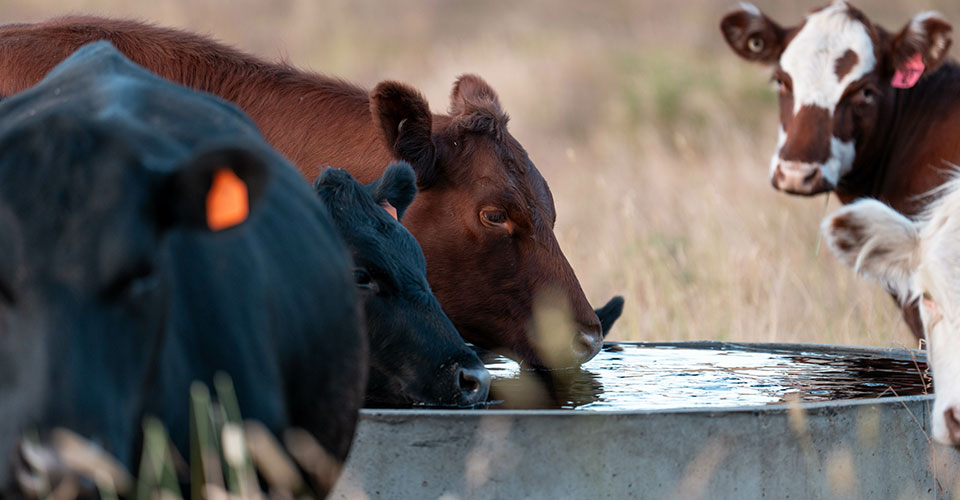
K-State beef cattle experts discuss cow efficiency and metrics that affect profitability.
Feb. 10, 2026
By Chevy-Lynn Vaske, K-State Extension news service
MANHATTAN, Kan. – When it comes to cow efficiency, beef producers often focus on outputs like weaning weights and pregnancy rates. K-State beef cattle experts recently discussed which performance metrics really matter on a recent Beef Cattle Institute Cattle Chat podcast episode.
Researchers defined cow efficiency as the relationship between feed intake and pounds of calf weaned per cow exposed, a metric that directly affects profitability. However, beef cattle nutritionist Phillip Lancaster suggested accurately measuring that relationship remains a challenge — especially when forage intake is involved.
“We as researchers need to work on these math equations to make them more accurate for the type of cows we have today,” K-State veterinarian Bob Larson said.
“We want to get to the point where we can measure efficiency better, but it is currently impossible to accurately measure forage intake,” Lancaster said.
Without precise intake data, researchers rely on models and indicators to evaluate how cows convert available resources into reproductive and growth outcomes.
Despite those limitations, the discussion reinforced several core principles producers can apply in their operations. The team stressed that efficiency is strongly tied to adequate nutrition, sound animal husbandry and maintaining proper body condition, particularly heading into calving.
“Sometimes the math clearly shows how thin cows going into the calving season can affect fertility and overall efficiency,” Larson said. Poor body condition at calving often results in delayed rebreeding, fewer pounds weaned and higher costs per cow — all of which reduce system efficiency.
While research continues to refine efficiency models, producers can protect herd performance by focusing on fundamentals: matching cow size to the environment, ensuring nutritional needs are met and managing body condition before calving begins.
To learn more about managing body conditioning for cows or learn more from the beef cattle experts, check out the BCI Cattle Chat podcast. For questions, reach out on social media or email to bci@ksu.edu.
***

K‑State Extension is a short name for the Kansas State University Cooperative Extension Service, a program designed to generate and distribute useful knowledge for the wellbeing of Kansans. Supported by county, state, federal and private funds, the program has county extension offices statewide. Its headquarters is on the K‑State campus in Manhattan. For more information, visit www.ksre.ksu.edu. K-State Extension is an equal opportunity provider and employer.