K-State research suggests higher omega-3 content can increase milk production
Research from the K-State Dairy Repro Lab indicates that omega-3 aids in milk production and is linked to reproduction changes
At a glance: K-State dairy specialist Victor Gomez-Leon says that adding omega-3 into dairy cattle diets increases milk production and blood flow during reproduction.
More information: Victor Gomez-Leon, 785-532-2652, vgomezleon@ksu.edu
Related: K-State Dairy Reproduction Lab Research
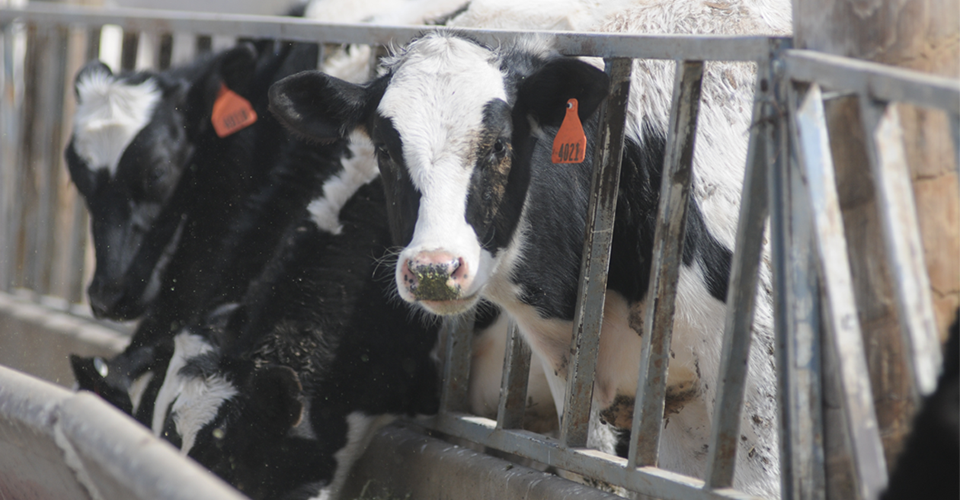
The K-State Dairy Research and Teaching Center conducted a study on adding omega-3 fatty acids into the diet of dairy cattle. File photo
Feb. 23, 2026
By Colton Tripp, K-State Extension news service
MANHATTAN, Kan. – With an ever-growing population, agriculturists and researchers continually strive to find new ways and innovations to enhance food production.
Following a recent trial at the Kansas State University Dairy Research and Teaching Center, one researcher suggests that a higher omega-3 diet in dairy cattle can increase milk production and aid in maintaining a pregnancy.
Victor Gomez-Leon, an assistant professor and dairy specialist with K-State Extension, said researchers found that dairy cattle that were fed a higher concentration of omega-3 over a 130-day trial period produced 2-4 pounds more milk compared to the control group that was fed a higher omega-6 diet.
Omega-6 in cattle feed is derived generally from corn and soybeans, whereas omega-3 comes from flaxseed in combination with an algae product. According to Gomez-Leon, this different type of feed combination allows the producers to feed the same amount of fat, just through a different fat profile. This feeding regime was started 15 days after calving and ended around 140 days after calving.
“What we saw in terms of milk production is that the cows fed the high omega-3 diet produce about 2-4 pounds more milk than cows fed low omega-3 diets,” Gomez-Leon said. “Our cows at the K-State Dairy Research and Teaching Center produce 100 pounds of milk per day, so the omega-3 cows were producing 102 to 104 pounds.”
Along with an increase of omega-3 in the cattle’s diet, researchers found there was an increase in the omega-3 content in the milk produced by these cows.
“Omega-6 activates mostly pro-inflammatory pathways, where omega-3 activates anti-inflammatory ones,” Gomez-Leon said.
Alongside the study’s research into the effects on milk and dairy production, it also looked into how omega-3 impacts reproduction in dairy cattle.
“We study the corpus luteum and progesterone, which are key components involved in maintaining pregnancy in cattle,” Gomez-Leon said. “We also evaluate the blood flow and the size of the ovary.”
Gomez-Leon added that researchers observed an increase in blood flow to the corpus luteum -- the structure that maintains the pregnancy -- at specific times during this trial.
He said: “While progesterone levels remained the same across diets, the observed change in the corpus luteum may represent physiologic advantages of feeding omega-3 to cattle, and align with other studies that reported a decrease in pregnancy losses.”
“One of the challenges that we have with both beef and dairy production is that the rumen, one of the four compartments in the cow's stomach, digests some of the omega-3, so it does not get absorbed well in the intestines,” Gomez-Leon said.
Through a proposed multidisciplinary study, K-State researchers hope to continue studying the inclusion of omega-3 in cattle diets, more specifically in beef-on-dairy research. Gomez-Leon said the researchers hope to understand if meat from calves born to dams fed omega-3 diets contains higher omega-3 content.
He adds that they will also aim to examine the effect of omega-3 on different dairy products. These studies should also help in the understanding of the underlying causes of pregnancy losses or maintenance across species.
More information on dairy cattle is available online from the K-State Department of Animal Science and Industry.
***

K‑State Extension is a short name for the Kansas State University Cooperative Extension Service, a program designed to generate and distribute useful knowledge for the wellbeing of Kansans. Supported by county, state, federal and private funds, the program has county extension offices statewide. Its headquarters is on the K‑State campus in Manhattan. For more information, visit www.ksre.ksu.edu. K-State Extension is an equal opportunity provider and employer.