Understanding coyote behavior may help humans avoid aggressive encounters
K-State wildlife expert discusses what one should know about coyote behavior during breeding season
At a glance: K-State wildlife specialist Drew Ricketts discusses the importance of understanding coyote behavior during breeding season.
More information: Drew Ricketts, 785-532-1949, arickett@ksu.edu
Related: K-State Extension Wildlife Management
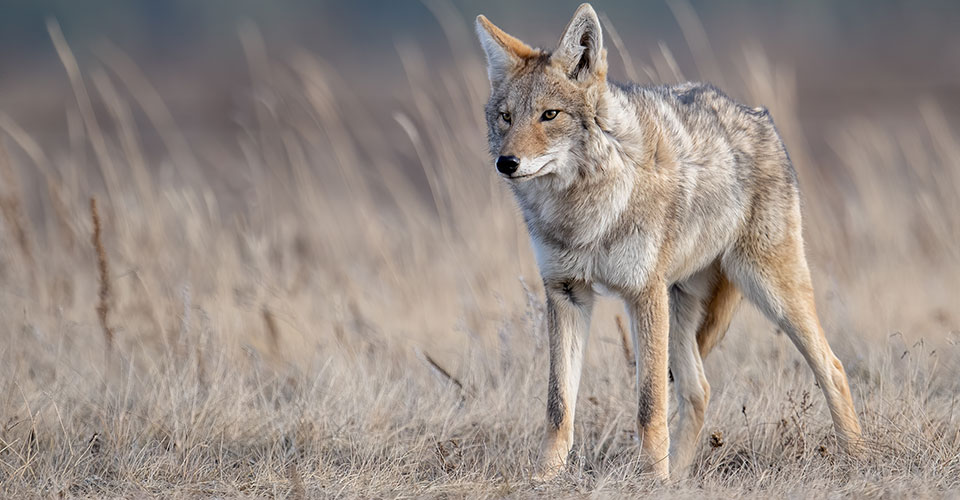
Coyote breeding season from January to March can cause the canine to be more active.
Feb. 10, 2026
By Colton Tripp, K-State Extension news service
MANHATTAN, Kan. – With coyote breeding season beginning, a Kansas State University wildlife expert explains that understanding the canine’s common behavior will help prevent and protect oneself from an aggressive encounter.
Drew Ricketts, a wildlife specialist with K-State Extension, said that the coyote breeding season starts at the beginning of January and ends around March. Based on data sets from Kansas, coyotes will become pregnant in February.
Listen to a portion of the podcast Fins, Fur and Feathers featuring Joe Gerken and Drew Ricketts.
With a 60-day gestation period, coyote pups will begin to be born around April. Having a lifecycle and developmental period like dogs, pups will be weaned around the eight-week mark, starting at the beginning of June.
“During the breeding season, coyotes are likely to be more active. We’re going to hear a lot more vocalizations like, howling, yipping and barking,” Ricketts said.
Ricketts explained the importance of understanding that if you see a coyote, and it looks at you, that is not a sign of aggressive behavior. However, if one starts to approach, that is a sign to watch out for. The most aggressive behavior that a coyote might exhibit would be attacking leashed pets the same size or smaller than themselves.
Coyotes begin to exhibit more territorial behavior during the breeding season, and during this time, they can become more aggressive towards pets – especially dogs that they may view as competitors.
“Starting around June is when we start to see a bigger food demand for coyote litters. And that’s when we can also see some shifts in their diet towards bigger prey items,” Ricketts said.
If a coyote starts to approach, Ricketts said to yell at the coyote and throw something at them. The goal is not necessarily to hit the coyote with the thrown objects, but to scare them, which can help instill the appropriate caution that coyotes ought to have.
Alongside demonstrating and setting that boundary for aggressive behavior, Ricketts gives examples of how to prevent aggressive behaviors in coyotes:
- Keep domestic pets on a leash. Do not leave small pets unattended, even in a fenced-in backyard.
- Do not have free choice of food and water available. Do not intentionally feed coyotes, as they will associate humans with food.
Ricketts stresses that a basic understanding of coyote behavior would help one protect themselves and their pets and animals from aggressive behavior.
More information on managing common wildlife animals in Kansas is available online from K-State Extension.
***

K‑State Extension is a short name for the Kansas State University Cooperative Extension Service, a program designed to generate and distribute useful knowledge for the wellbeing of Kansans. Supported by county, state, federal and private funds, the program has county extension offices statewide. Its headquarters is on the K‑State campus in Manhattan. For more information, visit www.ksre.ksu.edu. K-State Extension is an equal opportunity provider and employer.