Half of Kansas’ freshwater mussels are endangered or threatened: Here’s how experts are working to save them
K-State wildlife expert discusses efforts to reintroduce mussel populations
At a glance: Kansas' populations of freshwater mussels are declining due to pollution, fine sediment and the alteration of water flow due to damming. Researchers are working to raise and propagate mussels to repopulate these areas.
More information: Joe Gerken, 785-532-1418, gerkenj@ksu.edu
Related: Fins, Fur and Feathers (podcast)
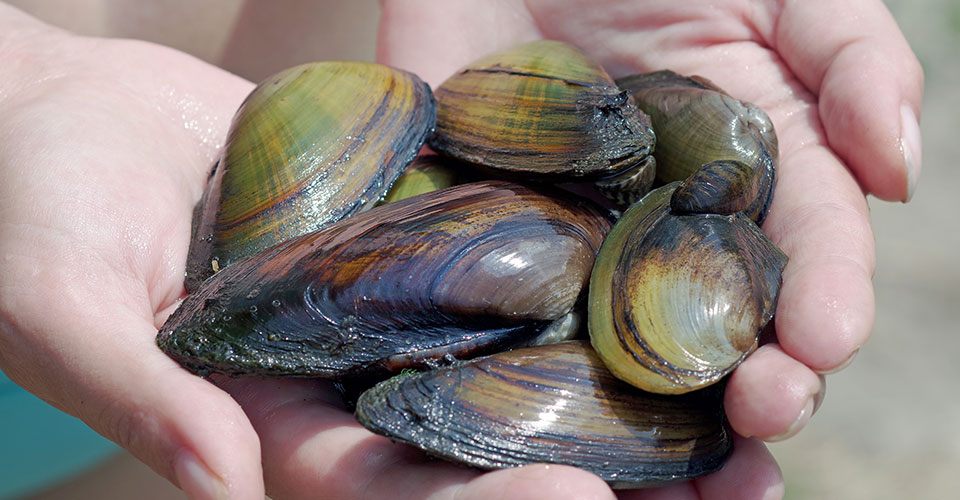
In large concentrations, mussels can help to filter out plankton and detritus, aiding in water clarity and quality.
Feb. 3, 2026
By Colton Tripp, K-State Extension news service
MANHATTAN, Kan. – If you have ever visited one of the many rivers or streams in Kansas, you may have encountered one of Kansas’ 40 different types of mussels.
If so, consider yourself lucky, because a Kansas State University wildlife expert says that more than half of these species are endangered or threatened in some way.
Joe Gerken, a fisheries and aquatic extension specialist with K-State Extension, said that populations of freshwater mussels are declining due to pollution, fine sediment and the alteration of water flow due to damming.
Mussels can be located across the whole state of Kansas. However, the main concentration of mussels is in the eastern part of the state, especially along the Neosho, Verdigris and Marais Des Cygnes rivers.
“But there are a couple species that do thrive in ponds,” Gerken said. “The paper pondshell is a common one that we have in Kansas. The pondhorn is another species.”
Freshwater mussels can range anywhere from 1-8 inches, with most of them in the 3–5-inch range. They are generally oval, and are brown in color, with some having hues of green or black.
“The bigger species might live 50, 60 to 100 years,” Gerken said. “Some of the smaller ones can grow up in a couple years and begin reproducing.”
He adds: “If you go out and you find something that has a hard shell and a gooey mush or mushy texture inside that, you know that’s a freshwater mussel.”
Mussels are filter feeders, which means they have incurrent and excurrent siphons that filter out plankton and detritus, such as broken-down leaves, that may be flowing through the water. When in large concentrations, mussels can aid in water clarity and quality.
“As we start talking about declining populations, that is something that we can maybe help control some of the pollution risk to re-establish some of these populations if we want to reclaim them in certain areas,” Gerken said.
Due to the decline of freshwater mussels, researchers at the Kansas Department of Wildlife and Parks are working to raise and propagate mussels to repopulate these areas. KDWP first released Fatmucket mussels into the Marmaton River in 2018. According to Gerken, this opened the door to allow KDWP to start improving population numbers of other endangered or threatened species, such as the Neosho Mucket mussel.
Gerken also highlighted the importance of restoring natural flow regimes in streams and rivers when possible. He added that this can prove to be difficult along major rivers for many reasons, including that the Army Corps of Engineers often regulates the flow of water for barges moving along the Missouri and Mississippi River Systems.
“But there is more thought into what we can do to maintain certain water flow, especially in smaller creeks and smaller rivers flowing into those bigger rivers,” he said. “Any changes we make may help keep freshwater mussels, including the threatened and endangered species, around for future generations.”
***

K‑State Extension is a short name for the Kansas State University Cooperative Extension Service, a program designed to generate and distribute useful knowledge for the wellbeing of Kansans. Supported by county, state, federal and private funds, the program has county extension offices statewide. Its headquarters is on the K‑State campus in Manhattan. For more information, visit www.ksre.ksu.edu. K-State Extension is an equal opportunity provider and employer.