Managing cattle nutrition during pasture recovery
K-State beef cattle expert outlines how to use donated hay wisely and protect cow body condition after a wildfire event
At a glance: Following recent prairie fires in western Kansas, cattle producers may face limited grazing options as burned pastures recover. Justin Waggoner, K-State beef cattle expert, advises ranchers to focus on strategic forage management.
More information: Justin Waggoner, jwaggon@ksu.edu
Related: Agriculture Today: Cattle Care After Fires
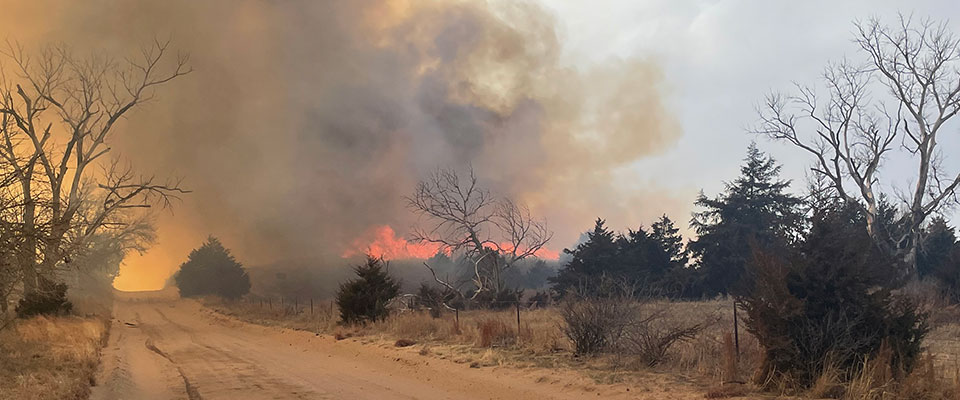
K-State beef cattle expert Justin Waggoner shares recommendations for producers to care for cattle after a wildfire.
March 3, 2026
By Chevy-Lynn Vaske, K-State Extension news service
MANHATTAN, Kan. — Persistent drought has already tested ranchers across western Kansas this winter — and now, prairie fires have added another layer of strain for cattle operations working to protect both land and livestock.
During a recent segment of Agriculture Today, Justin Waggoner, K-State beef cattle expert, shared practical recommendations for caring for cattle after wildfire events.
“The first priority is to make sure cattle are in a safe environment with access to clean water and feed,” Waggoner said.
“You may not be able to graze that burned grass for a while,” Waggoner said. “So the focus shifts to maintaining those cattle efficiently. Most of the time, it’s not just about having feed — it’s about using it smart.”
Listen to an interview by Shelby Varner with Justin Waggoner on the weekday radio program, Agriculture Today, produced by K-State Extension
Waggoner noted that in many wildfire situations, fellow producers step up to donate hay and supplemental resources — a gesture he says is deeply appreciated.
“It’s always appreciated when farmers donate hay,” he said. “But once those donations arrive, we have to be strategic in how we use them so we stretch those resources as far as possible.”
To help producers make informed decisions, donated hay is often separated into four quality categories based on nutrient content.
“The first category is low-quality hay, typically containing less than 7% crude protein,” Waggoner said. “That type of hay works well as a replacement for dormant native range. It can fill cows up, but it won’t provide a lot of additional nutrients.”
Moderate-quality hay includes forages such as brome or wheat hay, which offer improved protein levels and energy content.
“Moderate-quality hays step up the nutrient profile a bit,” he said. “They’re often a good fit for maintaining mature cows, depending on their stage of production.”
Higher-quality forages, such as alfalfa, are more nutrient-dense than most cows require on their own. Because of that, Waggoner recommends blending when possible.
“Alfalfa and other high-quality hays contain more nutrients than a dry cow may need,” he said. “That makes them excellent blending options. You can pair them with lower-quality forage to create a balanced ration and use your resources more efficiently.”
The final category includes higher-risk forages that may pose potential concerns, such as nitrate accumulation.
“Some forages can be higher risk, especially if there are nitrate concerns,” Waggoner said. “In those cases, you may want additional testing and more information before feeding. It’s better to know what you have than to guess.”
With spring calving underway or approaching for many Kansas operations, maintaining body condition is particularly important. Nutritional shortfalls during late gestation and early lactation can have long-term impacts on cow performance and reproductive success.
“In the spring, it’s calving time, and you have to be mindful of getting those cattle the nutrients they need without letting them lose body condition,” Waggoner said. “If cows lose too much condition now, it can affect them long term — from milk production to rebreeding.”
As producers navigate pasture recovery and feed inventories, Waggoner encourages them to work closely with local extension agents and nutritionists to evaluate forage quality and develop strategic feeding plans.
***

K‑State Extension is a short name for the Kansas State University Cooperative Extension Service, a program designed to generate and distribute useful knowledge for the wellbeing of Kansans. Supported by county, state, federal and private funds, the program has county extension offices statewide. Its headquarters is on the K‑State campus in Manhattan. For more information, visit www.ksre.ksu.edu. K-State Extension is an equal opportunity provider and employer.