Eastern Redbud blooms signal key time for lawn care
K-State horticulturist says that looking towards Eastern Redbud trees can help homeowners determine when to apply pre-emergent herbicide
At a glance: K-State Extension consumer hoticulture expert Matthew McKernan said that homeowners can use natural signs to determine when to apply pre-emergence herbicides.
More information: Matthew McKernan, mckernan@ksu.edu
Related: K-State Horticulure Newsletter
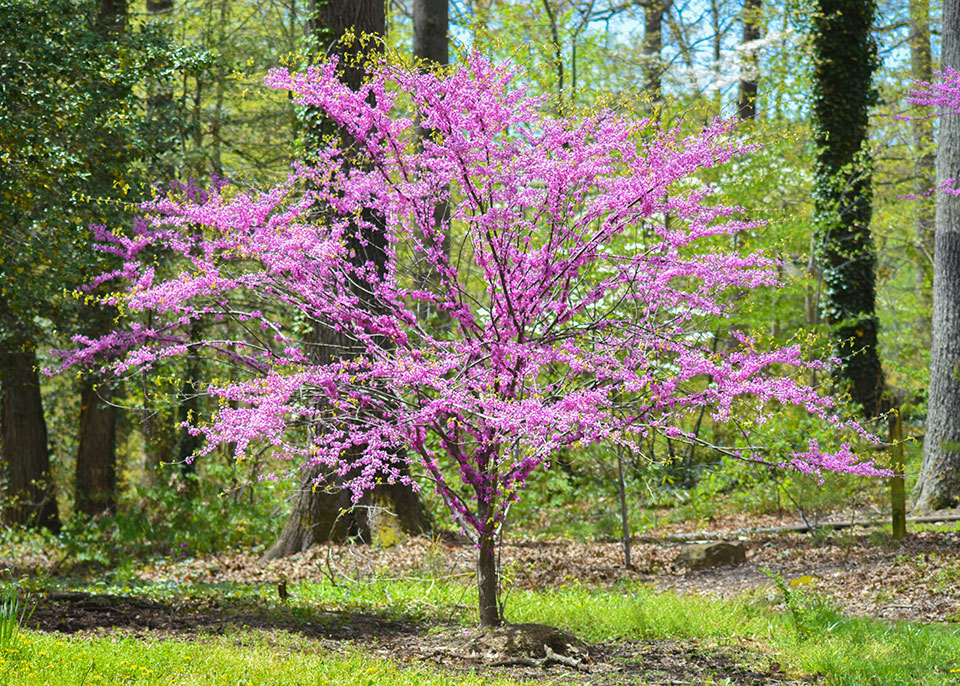
Matthew McKernan, K-State Extension consumer horticulture associate, said that the bright pink blooms of Eastern Redbud trees can serve as an indicator to start preventative measures for weeds in home lawns.
April 10, 2026
By Colton Tripp , K-State Extension news service
MANHATTAN, Kan. – One of the United States' most prestigious golfing events, The Masters, is held at the Augusta National Golf Club in Augusta, Georgia. Each year, attendees can expect major wins, blooming trees and flowers, and pimento cheese sandwiches with the event’s notoriously low prices.
Alongside the annual traditions, spectators can also walk and take in perfectly manicured and weed-free lawns that sprawl across the 345-acre golf club in eastern Georgia. But what if homeowners wanted to achieve those weed-free lawns themselves?
One Kansas State University horticulturalist said looking towards the Eastern Redbud tree can help guide timely lawn care.
“The Eastern Redbud bloom is a good indicator for timing of pre-emergence herbicide applications because it closely coincides with the soil temperature and environmental conditions that trigger germination of crabgrass and many other annual summer weeds,” said Matthew McKernan, a K-State horticulture expert. “When we see the redbud trees in bloom, we see a visual reminder that we need to take action to apply weed preventers.”
Eastern Redbud trees are native to Kansas, making them reliable signals of local growing conditions. When redbud trees reach full bloom, it serves as an indicator that crabgrass will quickly emerge, too.
“Because each spring in Kansas is different, we can’t reliably depend on a calendar date to mark our applications, so we look for natural indicators to help time our actions,” McKernan said.
Crabgrass begins to germinate when soil temperatures reach 57 to 64 degrees Fahrenheit. To make sure that a pre-emergent is applied at the appropriate time, one-inch soil depth temperatures need to have an average daily temperature of 55 degrees.
“The timing of weed preventers is critical because these products stop weeds from growing as the seeds germinate or start to grow,” he said. “Most weed preventers will have little to no effect on weeds that are already growing.”
If pre-emergence herbicides are applied too late, they often have no control over weeds that are already growing. If applied too early, herbicides risk the chance of breaking down and losing effectiveness before the growing season is over, allowing weeds to reemerge in late summer.
“A newer method of predicting crabgrass germination is using Growing Degree Day (GDD) models,” McKernan said.
Using formulas based on minimum air temperatures, GDD models measure the growth and development of plants and insects during the growing season. McKernan suggests using Michigan State University's GDD model to track pre-emergent timing and crabgrass germination.
“Most often, people apply pre-emergence herbicides in the spring to target and prevent crabgrass from being an issue in their lawn and landscape,” he said. “But properly timed spring pre-emergence herbicides can also be effective in preventing many other summer weeds, including goosegrass, foxtail, sandbur, barnyard grass, spurge, purslane, oxalis, puncturevine, annual pigweed and morning glory.”
Due to warm temperatures in Kansas and other areas this past winter, flower buds on redbud trees may have been damaged, meaning trees will not be as prominent this season with rosy-pink flowers. McKernan advises people to be more attentive when looking for this natural sign.
“Redbud trees will likely have less flowers to signal the timing of our weed preventers,” McKernan said. “In most cases a few flowers will still be present on redbud trees, but the visual reminder will likely not be as obvious this year, especially if people aren’t looking.”
Lastly, if homeowners want to achieve ‘Masters’ worthy lawns this summer, McKernan said that now is the time to act.
“Springtime maintenance in the lawn and landscape sets the stage for our success the rest of the growing season,” he said.
“Not only can applying weed preventers be one way we can reduce the workload later in the summer, but correct watering practices, mowing heights, and other maintenance practices can improve success and limit work during the summer months.”
More information on spring lawn maintenance is available online from the K-State Horticulture Newsletter, or from local K-State Extension offices in Kansas.
***

K‑State Extension is a short name for the Kansas State University Cooperative Extension Service, a program designed to generate and distribute useful knowledge for the wellbeing of Kansans. Supported by county, state, federal and private funds, the program has county extension offices statewide. Its headquarters is on the K‑State campus in Manhattan. For more information, visit www.ksre.ksu.edu. K-State Extension is an equal opportunity provider and employer.