Now is the time to scout for bagworms
Experts say that insecticides may need to be applied for up to four weeks
At a glance: Homeowners should scout for bagworms from early- to mid-May, says Shad Hufnagel, a forest health coordinator with the Kansas Forest Service. In some cases, insecticides may need to be applied for up to four weeks.
More information:
Raymond Cloyd, 785-532-4750, rcloyd@ksu.edu
Shad Hufnagel, 785-532-3300, smh8877@ksu.edu
Related: Kansas Forest Service | Bagworm: Insect Pest of Trees and Shrubs
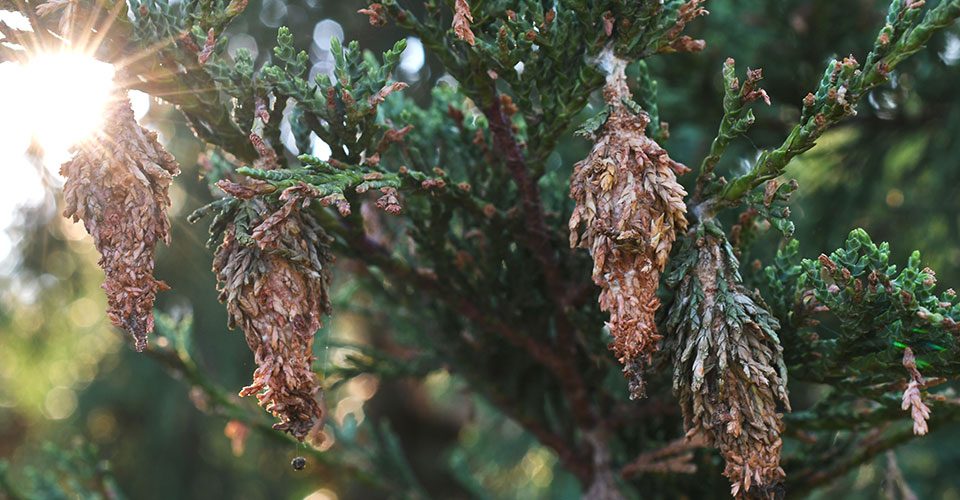
MANHATTAN, Kan. – A Kansas State University entomologist and a state forestry expert are urging patience and persistence when trying to manage bagworms, noting that caterpillars may emerge from eggs from late spring through early summer, depending on weather conditions.
Shad Hufnagel, forest health coordinator with the Kansas Forest Service, and Raymond Cloyd, professor and extension specialist in horticultural entomology with K-State Extension, advise that homeowners scout for bagworms from early- to mid-May and apply insecticides when young bagworms are present.
Once bagworms are detected, they said, homeowners might need to treat with an insecticide weekly for up to four weeks.
Cloyd said that in addition to emergence over time, young bagworms can ‘blow in’ -- called ‘ballooning’ -- from neighboring plants on silken threads, thus increasing the importance of treating multiple times during the growing season.
“Once the caterpillars emerge from eggs, they begin feeding on the host tree or shrub, creating a protective bag, hence the common name,” Cloyd said. “The plant material fed upon is used to build a protective covering that provides protection from predators and insecticide treatments, which can influence the effectiveness of insecticide applications.”
Hufnagel added: “The larger and more robust the caterpillars and their cases become, the more difficult they are to manage with insecticides.”
Bagworm feeding is commonly associated with conifers, such as juniper, arborvitae, pine, and spruce, but Hufnagel said the caterpillars also feed on many deciduous host plants. Although defoliation of deciduous trees and shrubs typically does not result in long-term plant damage, defoliation of conifers can cause substantial plant stress and result in plant mortality.
He said insecticides can be effective in mitigating damage to trees and shrubs. However, bagworm infestations are often cyclical; consequently, bagworm infestations may be low enough that spraying an insecticide may not be warranted.
For increased effectiveness and to prevent bagworms from causing substantial plant damage, Hufnagel advises judicious treatment of windbreaks, Christmas trees, and ornamental landscape trees as soon as bagworms are present.
“Thorough coverage is important when treating for bagworms, including penetration into the interior plant canopy and upper branches,” he said. “Commercial treatments may be more effective for large trees or established windbreaks where applications from common household sprayers cannot reach the upper canopy of trees.”
Many insecticides are labeled for bagworms, but timing of application and thorough coverage will ensure the effectiveness of insecticides in managing bagworms. When bagworm caterpillars are 1/8 to 1/4 of an inch long, products containing Bacillus thuringiensis subspecies kurstaki (Btk) or spinosad as the active ingredient can be effective in managing bagworms, according to Cloyd.
He adds that the recommended insecticides have minimal direct impact on beneficial insects compared to broad-spectrum insecticides, which could lead to outbreaks of spider mites or scale insects that can cause damage to treated trees and shrubs.
“If insecticides are not applied when bagworm caterpillars are 1/8 to 1/4 of an inch in length, then broad-spectrum insecticides, including those containing malathion, acephate, or cyfluthrin as the active ingredients can be applied,” Cloyd said. “Be sure to read the product label and follow directions before making applications.”
Hand removing and destroying bagworm bags is an option for smaller infestations.
For more information on controlling bagworms, reference the publication, Bagworm: Insect Pest of Trees and Shrubs, written by Cloyd and available online from the K-State Extension bookstore.
***

K-State Extension is a short name for the Kansas State University Cooperative Extension Service, a program that generates and distributes useful knowledge to support the well-being of Kansans. Supported by county, state, federal and private funds, the program has county extension offices statewide. Its headquarters is on the K‑State campus in Manhattan. For more information, visit www.ksre.ksu.edu. K-State Extension is an equal opportunity provider and employer.