Should you save trees damaged by storms?
K-State horticulture expert says not all trees should be salvaged
At a glance: K-State horticulture expert Matt McKernan shares management tips for homeowners whose trees were damaged by recent storms.
More information: Matt McKernan, hortsupport@ksu.edu
Related: Kansas Arborists Assocation | International Society of Arboriculture | K-State Horticulture Newsletter
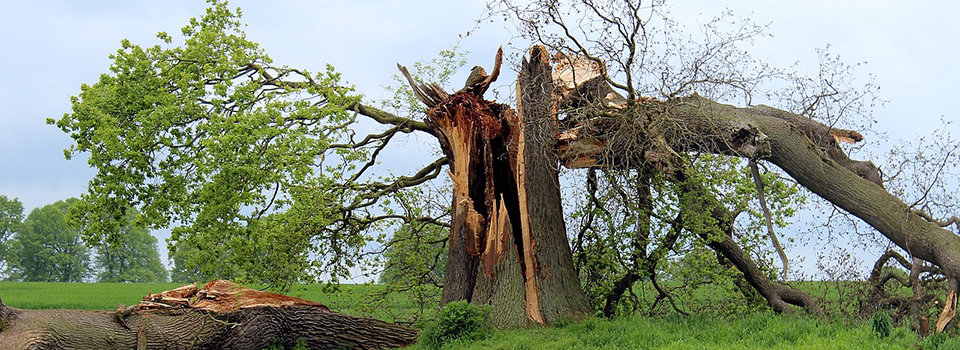
Storm-damaged trees with bark that has split and exposed the cambium or those where the main trunk has split are not likely to survive.
May 25, 2026
K-State Extension news service
MANHATTAN, Kan. – A Kansas State University horticulture expert says not all trees should be salvaged if they were damaged by storms and heavy winds that hit parts of Kansas recently.
From broken branches and dead limbs falling from trees, to entire trees being blown over at ground level, the extent of storm damage on trees can vary. Matt McKernan said landowners should evaluate trees to determine if the main trunk has split, if there is significant bark damage, or if the inner wood or cambium is exposed.
“These trees are not likely to survive,” McKernan said. “Don’t be afraid to remove the entire tree if severe damage occurred, as these trees pose future safety risks.”
Damaged trees may put on new growth, but McKernan notes that under such extreme stress they are much more susceptible to diseases, pests, and future branch breakage. These issues can create dangerous situations due to increased risk of further breaks.
“If the tree has so many broken limbs that the overall structure is altered, the tree may also be better off being replaced,” McKernan added. “Tree damage can often look worse than it is, so start by removing small debris from the area as you evaluate injury to the tree. If less than 50% of the overall tree is damaged, proper pruning and care can likely help save the tree.”
For trees with less damage, McKernan offers tips to help them heal:
- Prune broken branches to the next larger branch or the trunk. Do not cut flush with the trunk, but rather to the collar area between the branch and the trunk. “Cutting flush to the trunk creates a larger wound that takes longer to heal,” he said.
- Cut back large limbs progressively. The first cut should be made on the underside of the branch about 15 inches away from the trunk. This cut should be about one-third of the way up through the underside of the limb to prevent bark peeling when the weight of the branch is removed.
The second cut should be made a few inches out past the first cut, further away from the trunk of the tree. The second cut will begin on the top side of the branch and cut all the way through the branch, removing the weight of the limb.
A third and final cut should be made at the correct pruning point, just outside the branch collar, removing the remaining stub.
“It is important to be safe during the cleanup process,” McKernan said. He recommends always checking for downed power lines before starting cleanup efforts, as well as looking for broken branches that are still hanging in the tree canopy.
“If the tree is too big or the damage is too extensive, consult an expert,” McKernan said. “Look for an arborist who is both certified and insured.”
Arborists can be certified through either the Kansas Arborists Association or the International Society of Arboriculture. Additional help and information may be available at local extension offices in Kansas.
McKernan and his colleagues in K-State’s Department of Horticulture and Natural Resources produce a weekly Horticulture Newsletter with tips for maintaining home landscapes and gardens.
Interested persons can subscribe to the newsletter, as well as send their garden and yard-related questions to hortsupport@ksu.edu, or contact your local K-State Extension office.
***

K-State Extension is a short name for the Kansas State University Cooperative Extension Service, a program that generates and distributes useful knowledge to support the well-being of Kansans. Supported by county, state, federal and private funds, the program has county extension offices statewide. Its headquarters is on the K‑State campus in Manhattan. For more information, visit www.ksre.ksu.edu. K-State Extension is an equal opportunity provider and employer.