Kansas Profile – Now That’s Rural: Marcia Fish, alpacas
At a glance: When Marcia Fish wanted to do something with her family’s rural acreage, she and her husband settled on raising alpacas. Now she is using their alpaca fiber to produce one-of-a-kind handmade garments and accessories.
More information: Ron Wilson, rwilson@ksu.edu, 785-532-7690
Photos: Ron Wilson | Alpacas at Orchard Hill Farm
Website: Huck Boyd National Institute for Rural Development
May 6, 2026

By Ron Wilson, director of the Huck Boyd National Institute for Rural Development at Kansas State University
A package is arriving in Japan. It is an item made from alpaca fiber, crafted by an artisan and alpaca producer halfway around the globe in rural Kansas.
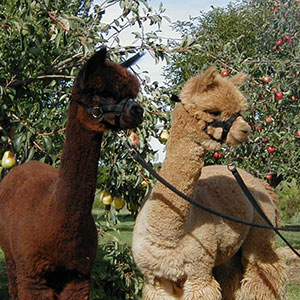 Marcia Fish and her husband are the owners of Alpacas at Orchard Hill Farm in northeast Kansas. She is the person who created the fiber item that went to Japan.
At left: Alpacas Frankie and Maya | Download this photo
Marcia grew up in Topeka but always wanted to live in the country and eventually moved to Jackson County. She and her husband own 14 acres near the rural community of Hoyt, population 593 people. Now, that’s rural.
After more than 30 years working for Southwestern Bell, she took early retirement.
“I’ve been crocheting since I was 16 years old,” Fish said. “My aunt taught me how to crochet at age 16.”
Years later, she and her husband were wanting to better utilize their 14 acres. “Somebody was cutting hay off it, but I wanted to do something more,” Fish said.
“I’m a big animal lover,” Fish said. “I thought about horses but they’re kind of big. I didn’t want something that would be butchered, like cows or pigs.”
One day she saw an ad about alpacas. “My husband liked them so we got some and started breeding them,” she said.
The Fishes have an active orchard so they named their operation Alpacas at Orchard Hill Farm. They raised alpacas and Marcia spins their fiber into yarn. She also uses the alpaca fiber to crochet or felt the fiber into one-of-a-kind accessories and garments.
At the beginning, Fish acquired two young females: Maya and Frankincense, or Frankie for short. She took them to an alpaca show in Iowa. Both alpacas claimed first place in their classes and Maya won a championship ribbon.
Those two outstanding females were the beginning of their registered herd that they bred and expanded through the years. The females gave birth to baby alpacas, which are called crias.
“It was so much fun going to alpaca shows,” Fish said.
Fish recently went to an alpaca show in Kansas City as a spectator. The official show judge happened to be the same person who Fish had first shown under some 20 years ago.
“As an exhibitor, you’re not supposed to talk to the judge,” Fish said. “This time I got to talk to her and it was so much fun.”
In the spring, a Colorado man passes through the region and shears the alpacas to harvest the fiber. “We save the best fleece and send it for cleaning to MM Fiber Mill and Good Shepherd Fiber Mill, both south of Louisburg,” Fish said. “The softest goes to make yarn. We spin the rest.”
She found the alpaca fiber was wonderful.
“It is soft as cashmere, not as scratchy as sheep’s wool, hypoallergenic and fire resistant,” Fish said. “It is five times warmer than sheep’s wool and sells for $2 an ounce.”
She creates jackets, hats, scarves and more which she markets at festivals and craft shows. “I like to go to festivals,” Fish said. “I go to the Renaissance Festival and four or five other festivals every year.”
The family’s orchard also is very active. “We have an orchard with 25 trees including different varieties of apples, pears, plums and peaches. We also have blackberries and grapes. My husband plants heirloom tomatoes. We’ll sell the produce and fruit or make jelly or apple butter and take it to farmer’s markets.”
Still, she notes how she especially enjoys the alpacas: “They’re kind of like cats. They will be friendly with you when they want to be.”
What does she like most about alpacas? “I love ‘em; they are unique animals,” Fish said. “They are smart and curious” and they grow beautiful fiber.”
For more information, find Alpacas at Orchard Hill Farm on Facebook.
We commend Marcia at Alpacas at Orchard Hill Farm for making a difference with homegrown products and handcrafted fiber art. It’s part of the fiber of rural America.
And there’s more. We’ll learn about the fiber mill next week.
Audio and text files of Kansas Profiles are available at www.huckboydinstitute.org/kansas-profiles. For more information about the Huck Boyd Institute, interested persons can visit www.huckboydinstitute.org.
***

K‑State Extension is a short name for the Kansas State University Cooperative Extension Service, a program designed to generate and distribute useful knowledge for the wellbeing of Kansans. Supported by county, state, federal and private funds, the program has county extension offices statewide. Its headquarters is on the K‑State campus in Manhattan. For more information, visit www.ksre.ksu.edu. K-State Extension is an equal opportunity provider and employer.