K-State agricultural economist says soil health practices may go hand-in-hand with farm profitability
Ifft says farmers benefit from reduced expenses when implementing soil health practices
At a glance: K-State agricultural policy extension specialist Jennifer Ifft shares research showing farms with higher soil health scores tend to be more profitable, primarily through reduced expenses.
More information: Jennifer Ifft, jifft@ksu.edu ,785-532-4486
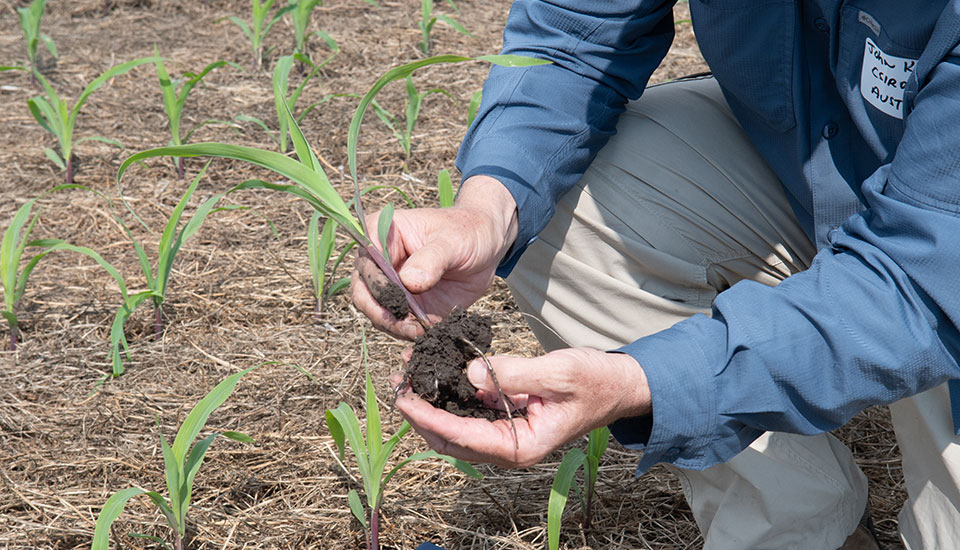
K-State researchers say improving soil health may be beneficial to total farm profit.
June 15, 2026
By Chevy-Lynn Vaske, K-State Extension news service
BUCYRUS, Kan. –As more Kansas farmers consider practices like no-till and cover crops, a common question remains: Do soil health practices pay off?
Research presented by Kansas State University agricultural policy specialist Jennifer Ifft at a soil health field day suggests the answer may depend less on how many practices are adopted, and more on how well those practices fit a farm's unique conditions -- especially location.
The findings stem from the master's thesis research of Delide Joseph, now a doctoral student in agricultural economics at Kansas State University. Working with the Kansas Farm Management Association, Joseph evaluated the relationship between regenerative soil health practices and farm profitability across Kansas operations. Ifft provided leadership for the project and developed the producer survey used in the research, while Joseph conducted much of the analysis and worked with an agronomy doctoral student to develop the soil health scoring system used in the study.
"We found that farms with higher soil health scores tended to be more profitable," said Ifft, speaking at the Kansas Soil Health Network Field Day at the Guetterman Brothers farm near Bucyrus.
"But," she added, "the key takeaway is that practices need to make sense for your area and your operation."
Among the practices gaining traction across the state, no-till remains one of the most widely adopted. Ifft said many producers are also experimenting with cover crops, although implementation often begins on a limited number of acres rather than across an entire farm.
"There is a lot of interest in these practices," Ifft said. "Many producers are trying cover crops and other soil health strategies, but often they're starting small and learning what works before expanding."
The research also revealed that younger farmers tend to be more likely to adopt regenerative practices. Farm size, however, did not appear to be a major factor in adoption.
To better understand the financial impacts of soil health management, researchers compared profitability measures among farms with varying levels of soil health practices.
She said younger producers often had higher operating expenses and lower profitability ratios, making it difficult to draw conclusions from simple comparisons alone. To account for those differences, researchers conducted a more detailed statistical analysis.
"Using one of our agronomic classifications, the highest-scoring farms had net farm income ratios that were about 5.6 percentage points higher," Ifft said.
The classification system was developed through Joseph's thesis research in collaboration with an agronomy doctoral student, allowing researchers to compare soil health management approaches across farms.
For a farm grossing $500,000 annually, that difference could translate into approximately $28,000 more net income.
However, the findings also showed that simply adding more soil health practices does not automatically increase profitability.
"When we looked at another classification method, there wasn't a consistent relationship between the number of practices being used and profitability," Ifft said. "Just having higher levels of practices on their own wasn't necessarily related to better financial outcomes."
Instead, researchers found that more profitable farms often benefited from lower expenses, rather than higher yields.
"We didn't find clear evidence that higher soil health scores consistently increased yields; we only have one year of research," Ifft said. "What we did see was that many of the more profitable farms had lower costs."
"Ultimately, using these practices in a way that fits your soils, climate and production system is where we see the greatest opportunity," Ifft said.
While the long-term yield impacts of some soil health practices continue to be studied, Ifft acknowledged that adopting new management approaches often requires additional planning, learning and time.
"These practices can be demanding to implement," she said. "There's a learning curve, and producers need to determine what works best for their operation."
Ifft credited the project as a collaborative effort and noted that Joseph's master's research formed the foundation of the study. While she provided leadership and survey development, Joseph led much of the analytical work behind the findings presented at the field day.
As interest in soil health continues to grow, the research suggests that profitability gains may come not from chasing a specific set of practices, but from strategically adopting management approaches that improve efficiency and fit the needs of individual farms.
***

K‑State Extension is a short name for the Kansas State University Cooperative Extension Service, a program designed to generate and distribute useful knowledge for the wellbeing of Kansans. Supported by county, state, federal and private funds, the program has county extension offices statewide. Its headquarters is on the K‑State campus in Manhattan. For more information, visit www.ksre.ksu.edu. K-State Extension is an equal opportunity provider and employer.