What is growing in my lawn?
K-State horticulture expert shares tips for removing mushrooms from the lawn
At a glance: Most mushrooms are relatively harmless to grass and other plant life. However, some may be associated with arc-like or circular patterns known as fairy rings, an outward fungal growth.
More information: Matt McKernan, hortsupport@ksu.edu
Related: K-State Horticulture Newsletter | Fairy Rings in Turfgrass
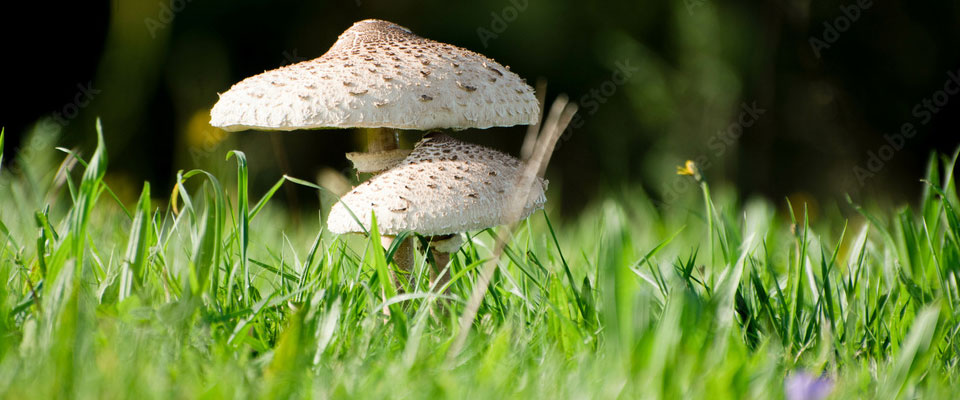
If mushrooms in a lawn are a nuisance, homeowners can pick and dispose of them as soon as they appear, says K-State horticulture expert Matt McKernan.
June 30, 2026
K-State Extension news service
MANHATTAN, Kan. — Many parts of Kansas have received enough moisture this spring and early summer to cause mushroom growth in home lawns and gardens. Kansas State University horticulture expert Matt McKernan said most are relatively harmless to surrounding plant life.
“Some of these mushrooms are associated with arc-like or circular patterns in turfgrass called fairy rings. The ring pattern is caused by the outward growth of fungal mycelium,” McKernan said. “The mycelium forms a dense, mat-like structure in the soil that decomposes organic matter.”
McKernan said this decomposition releases nitrate into the soil, which in turn stimulates the growth of the grass at the outer portion of the ring. This results in a dark green appearance of the grass at the margin of the ring.
“Unfortunately, in some instances the thick fungal mat formed by the fungus interferes with water infiltration. The fungus also may release certain byproducts that are toxic to the turf,” McKernan said. “This may lead to dieback of the turf close to the ring.”
McKernan said fairy rings are difficult to control.
“You can sometimes eliminate the ring by digging to a depth of 6-12 inches and 12 inches wide on both sides of the ring, refilling the hole with non-infested soil,” McKernan said.
Commercial lawn care companies may use fungicides to control fairy rings but these products are not available to homeowners.
“Most mushrooms in lawns, however, are not associated with fairy rings. These may be mycorrhizal (symbiotic association with tree roots) or saprophytic (living on dead organic matter such as wood or other material) in the soil,” McKernan said.
These mushrooms often appear randomly in the lawn and landscape, with no discernable pattern. McKernan recommended not killing these mushrooms because they can be beneficial, providing important environmental services such as decomposition of dead plant materials.
“A fungicide spray to the mushroom itself does little good. Remember the mushroom is simply the fruiting structure of the organism,” he said. “Most of the fungus is below ground and inaccessible to the chemical. The above-ground mushroom only produces and spreads fungal spores.”
If mushrooms are a nuisance, McKernan encourages picking them and disposing of them as soon as they appear. If there are too many for that to be practical, mow them off. Either option prevents children or pets from accidentally consuming unknown mushrooms.
McKernan warns that some of the mushrooms in the lawn are poisonous. Never eat mushrooms unless you are sure of their identity.
“Mushrooms tend to go away as soil dries. Patience may be the best control,” he said.
McKernan and his colleagues in K-State’s Department of Horticulture and Natural Resources produce a weekly Horticulture Newsletter with tips for maintaining home landscapes and gardens.
Interested persons can subscribe to the newsletter, as well as send their garden and yard-related questions to hortsupport@ksu.edu, or contact your local K-State Extension office.
***

K‑State Extension is a short name for the Kansas State University Cooperative Extension Service, a program designed to generate and distribute useful knowledge for the wellbeing of Kansans. Supported by county, state, federal and private funds, the program has county extension offices statewide. Its headquarters is on the K‑State campus in Manhattan. For more information, visit https://extension.ksu.edu. K-State Extension is an equal opportunity provider and employer.