In the Garden: Virus, fungal disease gain foothold on state’s roses
K-State horticulture expert shares tips on what you can do to protect roses
At a glance: K-State horticultural expert Matt McKernan says many gardeners in the state aren’t feeling too rosey about their roses these days. A virus and a fungal disease may be to blame.
More information: Matt McKernan, hortsupport@ksu.edu
Related: K-State Horticulture Newsletter
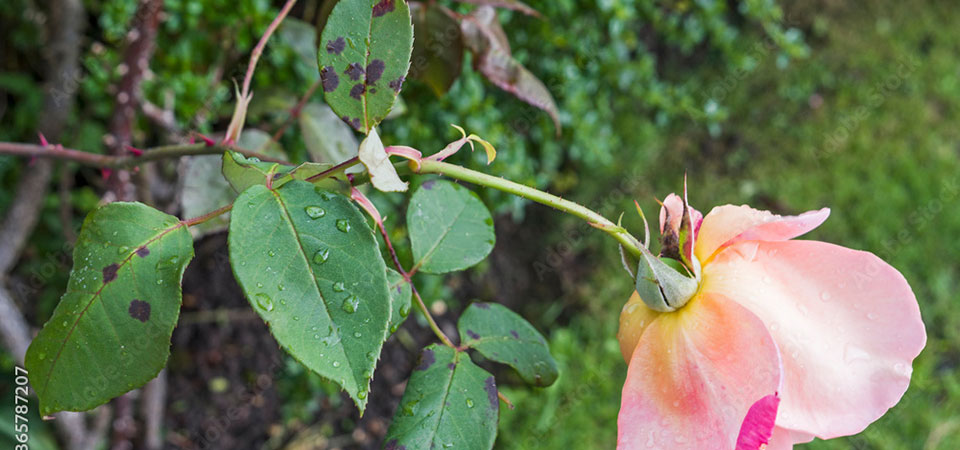
Gardeners in some areas of Kansas are reporting problems with their roses. K-State horticulture expert Matt McKernan says the rosetta virus and blackspot (pictured) could be causing the problems.
June 18, 2026
K-State Extension news service
MANHATTAN, Kan. – Kansas State University horticultural expert Matt McKernan says many gardeners in the state aren’t feeling too rosey about their roses these days.
“Several counties are reporting problems with their roses,” McKernan said. “One of those problems is the rose rosette virus.”
The classic symptoms of the virus include:
- Rapid elongation and thickened stems of new shoots.
- ‘Witches broom,’ or a clustering of small branches.
- Branches developing excessive thorns.
- Small, deformed, reddish-purple leaves.
- Certain varieties may develop streaks or blotches of reddish-purple on stems and petioles.
- Plant death.
Plants exhibiting these symptoms should be removed and destroyed, including the roots. McKernan recommends garden tools that come in contact with infected plants need to be sterilized to avoid spreading the virus.
“Once a plant is infected with rose rosette disease, there is unfortunately no cure,” McKernan said. “That is why it is critical to eliminate infected plants when they are encountered, to limit the disease spread.”
Blackspot, a fungal disease, is also being reported in parts of Kansas. McKernan said some of the common symptoms of blackspot include:
- Dark, circular lesions with feathery edges develop on the upper leaf surface; usually the lower leaves of the plant are infected first.
- Raised, purple spots on young canes.
- Yellowing between spots on infected leaves.
- Leaf drop.
“Prevention is the best approach for controlling blackspot,” said McKernan, who adds that purchasing resistant cultivars of roses is one of the best prevention steps.
Also, “use drip irrigation to avoid splashing water on the leaves when irrigating,” he said. “Ensure the roses are planted in the sun with good air movement, and do not crowd plants together in a planting. Diseased leaves should be removed from the ground, and infected plant parts should be pruned out of the plant.”
Gardeners may also choose to apply a fungicide. McKernan suggests choosing a fungicide that you can apply on a 10-14 day schedule starting at the first sign of disease, and continuing through periods of warm, wet weather.
He said some of the recommended fungicides include myclobutanil (Immunox, Immunox Plus); chlorothalonil (Broad Spectrum Fungicide, Garden Disease Control); triticonazole (Ortho Rose and Flower Disease Control); tebuconazole (Bayer Disease Control for Roses, Flowers and Shrubs); and copper-based fungicides (Basic copper sulfate, Bonide Copper Fungicide, or Tenn-Cop).
“As always, follow all label instructions carefully,” McKernan said.
“Despite some of the challenges with roses, they can still be a great plant for the Kansas landscape,” McKernan added. “Their success, however, depends on choosing the right hardy, disease‑resistant variety, and frequently monitoring roses for pest problems to address issues as they emerge.”
McKernan and his colleagues in K-State’s Department of Horticulture and Natural Resources produce a weekly Horticulture Newsletter with tips for maintaining home landscapes and gardens.
Interested persons can subscribe to the newsletter, as well as send their garden and yard-related questions to hortsupport@ksu.edu, or contact your local K-State Extension office.
Brand names appearing in this article are for identification purposes only and do not represent an endorsement of any particular product.
***

K‑State Extension is a short name for the Kansas State University Cooperative Extension Service, a program designed to generate and distribute useful knowledge for the wellbeing of Kansans. Supported by county, state, federal and private funds, the program has county extension offices statewide. Its headquarters is on the K‑State campus in Manhattan. For more information, visit www.ksre.ksu.edu. K-State Extension is an equal opportunity provider and employer.