Kansas Profile – Paul Mai
At a glance: When Paul Mai came to the U.S. from Germany, he had $26 in his pocket. Working in the steel industry, he began a one-man welding shop that grew into businesses that did metal fabrication, steel supply, transportation, and more, and have shipped products around the world.
More information: Ron Wilson, rwilson@ksu.edu, 785-532-7690
Photos: Ron Wilson | Paul Mai
Website: Huck Boyd National Institute for Rural Development
June 3, 2026

By Ron Wilson, director of the Huck Boyd National Institute for Rural Development at Kansas State University
He arrived in the U.S. with $26 in his pocket, yet he lived to experience the American dream.
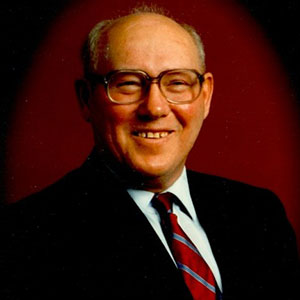 The late Paul Mai immigrated from Germany in 1958, moved to Kansas, and became globally recognized in the steel fabrication business. It’s a remarkable story in rural entrepreneurship.
Paul Karl Mai was born in Germany in 1931. The eldest of four sons, he worked as a steel laborer in post-war Germany. Some older friends encouraged him to go the U.S. and he began to dream of doing so.
At left: Paul Mai | Download this photo
In 1958, a family member living in Topeka sponsored he and his brother’s immigration to the United States. They traveled by ship to Ellis Island and then by train to Topeka.
In later years, Dave Cox worked for Mai and considered him a mentor. Cox shared several memories of Paul Mai.
“In Germany, his dream was to come to the U.S. and build a business, and that’s what he did,” Cox said. “He was a visionary.”
In the U.S., Mai first worked as a general laborer in concrete and steel businesses. According to Cox, Mai would spend his after work hours drawing designs of equipment that could help do the work better and more efficiently. His supervisors took notice and began to promote him.
This was during the era of the Cold War with the Soviet Union. Among the first projects Mai worked on were construction of underground concrete and steel missile silos to respond to the Soviet nuclear threat.
Several of those silos were concentrated around air bases at Topeka and Salina, but there were also missile sites in such rural communities as Waverly, population 574; Delia, population 151; and Bushong, population 27 people. Now, that’s rural.
Mai moved to Salina and started a one-man welding shop called Mai Steel Services. He met and married Betty Mai and they had four children.
With his entrepreneurial spirit and commitment to innovation, he began to expand and invest in other businesses. “He was always looking for ways to work smarter, not harder,” Cox said.
He did lots of work with concrete and steel. One early enterprise was a business named Stress-Cast that worked on prestressed concrete construction.
As he focused more on steel products, he began with small repair jobs such as a local middle school gymnasium followed by the bombing range observation towers at Fort Riley.
“He wanted to be a turnkey supplier of metal structures,” Cox said. The business he founded is now known as PKM Steel Service.
Mai began with welding projects but found he needed a reliable and readily accessible supply of raw steel. That led him to build his own steel warehouse in Salina. That business is known as Salina Steel Supply.
The next issue he encountered was issues around the transport of related products. That led to the founding of his own trucking company, now known as MSS Transport.
He would later form MaiCo Industries and A-Plus Galvanizing. He patented an invention called the Mai Sky System for the steel industry, built the world’s largest galvanizing kettle, and shipped fabricated steel and heavy steel structures throughout the United States and to countries all around the world.
“I’m blessed to have been mentored by Paul,” Cox said. “I traveled with him to Germany and China. In the steel industry, people knew him all over the world.”
His impact extended far beyond the business world as he made significant contributions to local community projects and education. For example, his generous support of welding schools and lifelong learning earned him the Teacher’s Apple Award. He also provided support to young, aspiring entrepreneurs in central Kansas.
Paul Mai passed away in 2017. His family continues to own and operate these major companies.
We salute Paul Mai and family for making a difference with innovation and entrepreneurship from humble beginnings. He could truly say, “I did it Mai way.”
And there’s more. Among those businesses was one that has become a national leader in the tubular pole and building structure business. We’ll learn about that next week.
Audio and text files of Kansas Profiles are available at www.huckboydinstitute.org/kansas-profiles. For more information about the Huck Boyd Institute, interested persons can visit www.huckboydinstitute.org.
***

K‑State Extension is a short name for the Kansas State University Cooperative Extension Service, a program designed to generate and distribute useful knowledge for the wellbeing of Kansans. Supported by county, state, federal and private funds, the program has county extension offices statewide. Its headquarters is on the K‑State campus in Manhattan. For more information, visit www.ksre.ksu.edu. K-State Extension is an equal opportunity provider and employer.