Nearly 50 years of Fusarium workshops leave global legacy at Kansas State University
Biennial gathering in Manhattan will end quarter-century run in June
At a glance: For more than a quarter century, scientists from around the world have traveled to Kansas State University to study one of agriculture’s most persistent and widespread threats: Fusarium, a large genus of filamentous fungi widely found in soil and on plants. This year’s Fusarium Workshop, scheduled June 21-26, will mark the final time the internationally recognized program is hosted at K-State.
Photo: John Leslie in laboratory setting
More information: John Leslie, jfl@ksu.edu
Related: K-State Fusarium Workshop
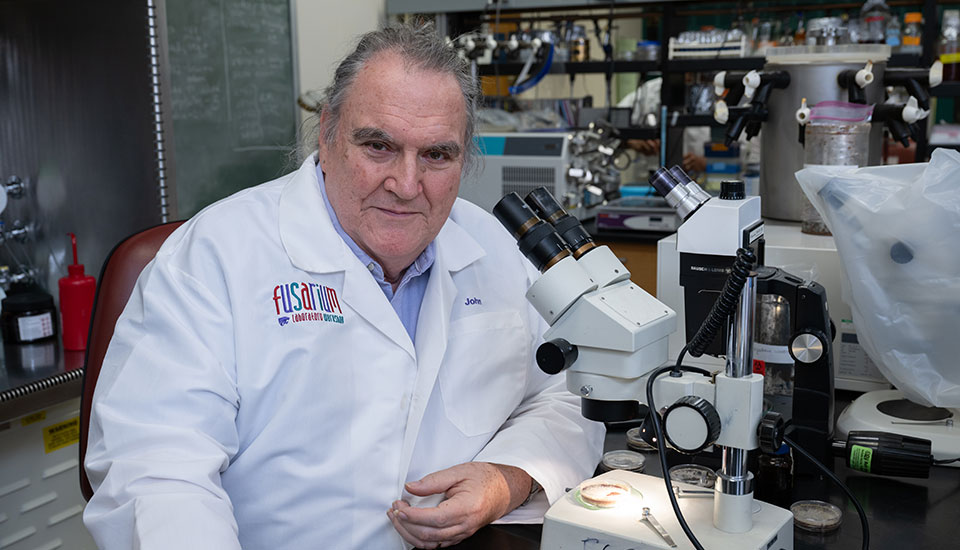
K-State professor of plant pathology John Leslie has been involved in some fashion in every national and international fusarium workshop over the past 50 years. | Download this photo
June 1, 2026
By Pat Melgares, K-State Extension news service
MANHATTAN, Kan. — For more than a quarter century, scientists from around the world have traveled to Kansas State University to study one of agriculture’s most persistent and widespread threats: Fusarium, a large genus of filamentous fungi widely found in soil and on plants.
This year’s Fusarium Workshop, scheduled June 21-26, will mark the final time the internationally recognized program is hosted at K-State. The workshop, which began in 1977 at the University of Minnesota, has been based at K-State since 2000, held in Manhattan every other year and at alternate sites on five different continents, when not in Manhattan. By next year, organizers say the program will represent nearly 50 years of these multi-institutional workshops
For John Leslie, K-State professor of plant pathology and one of the workshop’s longtime leaders, the program’s greatest accomplishment may be the global scientific network it created.
“Once we do this year’s workshop, over 25 years, we will have had more than 800 participants from more than 70 countries,” Leslie said.
The workshops alternate between the United States and international locations, bringing together researchers, diagnosticians, crop breeders, plant pathologists, industry leaders and others to study Fusarium fungi and the diseases and toxins they produce.
“Usually there are somewhere between eight and 12 instructors,” Leslie said. “When we help our international friends conduct workshops that follow our format, we say, ‘Here are the international scientists that you have to invite as a core set of instructors across locations, and then you need to get colleagues from your country to fill in some of the other roles.’”
The result, he said, is “a very functional network” of scientists working together across borders.
Fusarium is among the most studied fungal groups in the world because of its enormous impact on agriculture, food safety and global trade.
“At an international congress on mycology, Fusarium is usually the number one or number two most commonly studied fungus,” Leslie said.
He said these fungi infect a wide range of crops, from tomatoes, cucumbers and beans in home gardens to major commodity crops such as corn, wheat, sorghum and barley.
“There’s a poster down the hall from my office that says, ‘If it’s green, it gets Fusarium,’” Leslie said. “And whenever it gets Fusarium, often it doesn’t do good things.”
One of the best-known examples involves bananas. Leslie recalled how television commercials in the 1960s suddenly began featuring a “dancing banana” promoting a newer variety.
The previous banana variety had been devastated by Fusarium disease.
“Now we’re having a problem with Fusarium on bananas again, threatening to wipe out banana production worldwide,” Leslie said. “In some parts of the world, bananas are a staple food source, so it can be a real threat to indigenous food security.”
Fusarium also produce dangerous compounds known as mycotoxins, which contaminate food crops and create risks for both livestock and humans.
Fusarium species can produce toxins such as fumonisins, trichothecenes and zearalenone, commonly found in cereal grains including corn, wheat and barley. According to the National Institutes of Health, exposure to high levels of mycotoxins can cause vomiting, diarrhea, abdominal pain, fever and immune system damage. They are linked to throat cancer and to birth defects in new borns. In severe cases, exposure can be fatal.
“The threats to people from Fusarium are from the secondary metabolites, from the mycotoxins that they produce,” Leslie said.
One major concern in the Great Plains is Fusarium head blight in wheat, largely caused by Fusarium graminearum. The disease reduces grain quality and can leave crops contaminated with toxins.
The economic consequences can be devastating. Leslie said barley grown for malting, for example, can lose nearly all of its value if contaminated.
“If it’s got this toxin on it, then it is no longer usable as malting barley, and it goes to feed barley,” he said. “When it does, the price goes from 100% to 10%.”
Leslie said the disease has reshaped agricultural economies across parts of the Upper Midwest and Northern Plains. As shorter-season corn hybrids expanded northward, Fusarium overwintering on corn residue began infecting wheat crops more frequently.
The workshop itself focuses on helping scientists accurately identify Fusarium species and understand the biology behind the diseases they cause.
Leslie said multiple species of Fusarium can cause problems, and their hosts and the problems they cause are different as well. No single species is responsible for all of the problems caused by Fusarium.
“The foundation of the workshop has always been being in the lab and observing culture morphology,” Leslie said. “We’ll probably have 60 different species of Fusarium out for people to look at.”
Participants study the fungi side by side — a rare opportunity even for experienced researchers.
“This is one of the few opportunities that (they) will ever have to look at that many species at more or less the same time,” Leslie said. “We always tell participants that’s the most important thing to do.”
Over the years, the curriculum has expanded beyond traditional microscopy and taxonomy to include molecular biology, population genetics, toxin biosynthesis and plant pathology.
“The Fusarium workshop is to help people be able to reliably identify the different fungi,” Leslie said. “They get some molecular biology, they get some population genetics, they get molecular plant pathology and toxin biosynthesis.”
Participants leave with enough background knowledge, he said, to understand high-level scientific presentations and collaborate across disciplines.
Accurate identification is increasingly important in a global agricultural economy because fungal names can influence trade decisions.
“The name we put on it really matters,” Leslie said. “You can end up with huge import-export fights” if countries classify causal fungi differently, even if the diseases are the same.
The classification of Fusarium species itself has long been debated. Around 1900, scientists recognized roughly 1,500 species. By the 1950s, some taxonomists reduced the number to only nine.
“That was a big mistake,” Leslie said. “There were things that are definitely different species that were then called the same thing.”
Modern molecular tools have improved classification, though disagreements remain over how much genetic difference is needed to define a new species.
The workshop also examines how fungal toxins can serve scientific and industrial purposes. Fumonisin, for example, is widely studied because it triggers a form of natural cell death useful in medical research, including cancer studies.
Another toxin, zearalenone, has estrogen-like effects and is carefully regulated in food supplies. Researchers have also modified this compound into products used in livestock production.
Leslie said the workshop’s impact extends far beyond academic research.
“What we’re ultimately trying to do is reduce the incidence of Fusarium diseases, which means plant yields are higher, there are fewer toxins in food, and there is more food and it is safer to eat,” he said.
The workshop has also become a “flagship program” for K-State’s Department of Plant Pathology, according to Leslie.
“We are known all over the world for running these workshops, and for people really liking them.”
The future of the workshops has not yet been decided, but Leslie notes that colleagues at other U.S. universities have an interest in continuing them, ensuring the program continues under new direction while continuing to adapt to emerging technologies and scientific advances.
Leslie expects the workshop’s collaborative spirit to remain intact and be extended to include a new generation of researchers working on these fungi.
“Because we’ve been so many places, had so many different kinds of people, those are all things that strengthen the network,” he said. “People walk out of here knowing pretty well at least 10 or 12 of 30 to 50 participants. You just expanded your network by a lot.”
More information on this year’s workshop is available online from K-State’s Department of Plant Pathology.
***

K‑State Extension is a short name for the Kansas State University Cooperative Extension Service, a program designed to generate and distribute useful knowledge for the wellbeing of Kansans. Supported by county, state, federal and private funds, the program has county extension offices statewide. Its headquarters is on the K‑State campus in Manhattan. For more information, visit www.ksre.ksu.edu. K-State Extension is an equal opportunity provider and employer.