In the garden: Am I growing plants, or feeding grasshoppers?
Gardeners face annual battle of protecting crops from aggressive insect
At a glance: K-State horticulture expert Matt McKernan said many grasshopper varieties make their home in gardens this time of year, preferring the luxurious accommodations – rife with leaves, flowers, stems and seeds – as they molt and mature.
More information: Matt McKernan, hortsupport@ksu.edu
Related: K-State Horticulture Newsletter | Grasshoppers in the Lawn and Garden
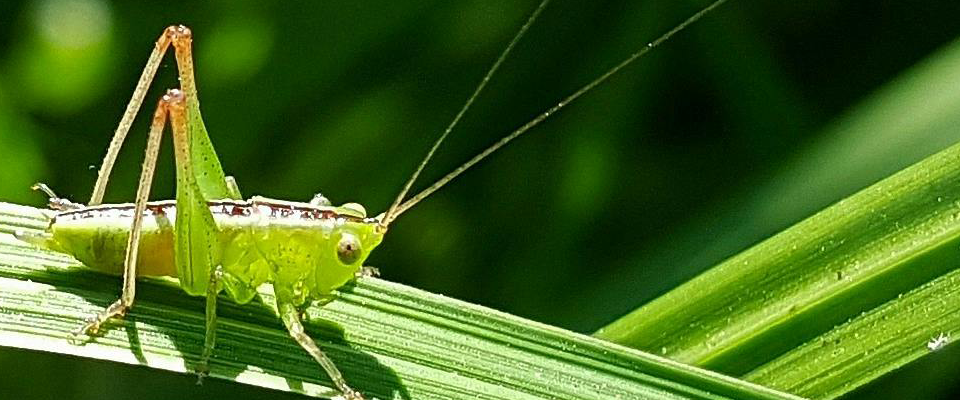
Grasshoppers are one of the most destructive garden pests. Early detection is key to limiting their damage, says K-State horticulture expert Matt McKernan.
July 20, 2026
K-State Extension news service
MANHATTAN, Kan. – If gardeners get this eerie feeling that they’re feeding grasshoppers right now, they’re likely not alone.
Kansas State University horticulture expert Matt McKernan said many grasshopper varieties make their home in gardens this time of year, preferring the luxurious accommodations – rife with leaves, flowers, stems and seeds – as they molt and mature.
Grasshoppers have huge appetites and sharp, chewing mouth parts to damage fruit, defoliate trees, or even devour entire plants. They are considered one of the most destructive garden pests.
“Full-sized adults are the most problematic because they have wings and can move long distances,” McKernan said. “They also have tougher skin, making insecticides less effective.”
Gardeners should act early if they detect grasshopper infestations.
“Nets and floating row covers can be effective protection for small areas, though grasshoppers have been known to chew through netting,” McKernan said. “Gardeners who want to avoid insecticide treatments have to decide the amount of damage to garden plants that they can tolerate. In suburban areas, it is important for gardeners to work together to control grasshoppers and limit the destruction.”
McKernan said insecticides are usually effective when the spray comes into direct contact with the grasshopper. This will be most effective if applications are made just before or at sunrise, when grasshoppers are less active.
“Most insecticides have to be re-applied to eliminate new arrivals,” he said. “Target hatching areas and immature grasshoppers whenever possible, as they are limited in their range since they travel by foot. They are easiest to control at this stage.”
For updated recommendations on pesticides, including a protocol for applying them, gardeners are encouraged to contact their local K-State Extension office.
McKernan and his colleagues in K-State's Department of Horticulture and Natural Resources produce a weekly Horticulture Newsletter with tips for maintaining home landscapes and gardens. The newsletter is available to view online or can be delivered by email each week.
Interested persons can subscribe to the weekly newsletter, or submit their garden and yard-related questions, by sending email to hortsupport@ksu.edu. More information also is available at your local K-State Extension office.
***

K‑State Extension is a short name for the Kansas State University Cooperative Extension Service, a program designed to generate and distribute useful knowledge for the wellbeing of Kansans. Supported by county, state, federal and private funds, the program has county extension offices statewide. Its headquarters is on the K‑State campus in Manhattan. For more information, visit https://extension.ksu.edu. K-State Extension is an equal opportunity provider and employer.