K-State horticulture agent says local food systems are interdependent
Reardon explains how extension helps to support food systems within Kansas communities
At a glance: K-State Extension horticulture agent Anthony Reardon says the state's landgrant network is uniquely positioned to support food production, distribution and access at every step of the food system.
More information: Anthony Reardon, anthony.reardon@jocogogov.org
Related: Kansas Local Foods | Kansas Rural Grocery Initiative
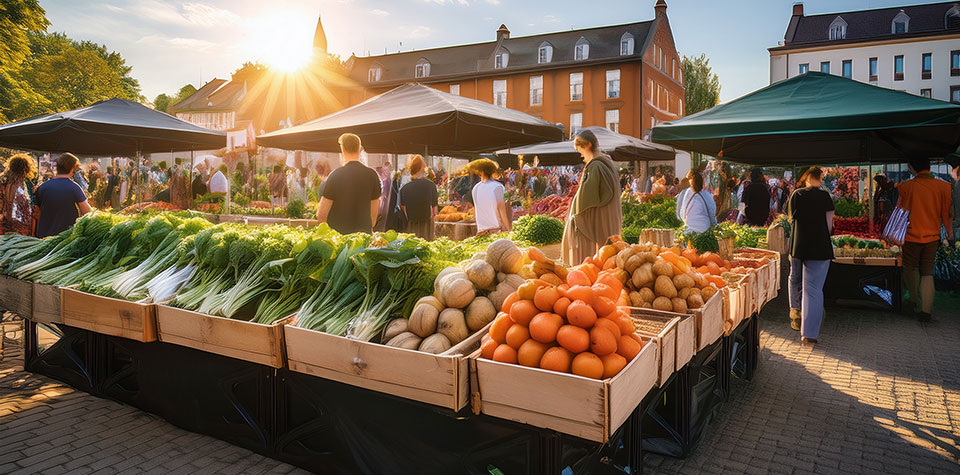
“Food is a foundational need,” says K-State Extension horticulture agent Anthony Reardon, adding that local food systems that are both sustainable and resilient lead to better food access for everyone.
July 27, 2026
By Pat Melgares, K-State Extension news service
MANHATTAN, Kan. -- From seed libraries to community gardens and business coaching for food entrepreneurs, K-State Extension is stitching together a statewide network of programs designed to strengthen local food systems, while ensuring that Kansans have access to healthy food now and in the future.
Speaking during the July K-State Garden Hour webinar, Anthony Reardon, a horticulture agent specializing in small farms for K-State Extension’s Johnson County office, said extension is uniquely positioned to support food production, distribution and access at every step of the food system.
“Food systems are highly nuanced, interconnected and interdependent,” Reardon said. “When one part breaks down, the rest can’t function the way they’re meant to.”
Reardon compared food systems to the cogs of an antique clock: when one cog fails, the entire mechanism slows or stops. He noted that extension’s presence in horticulture, agriculture, natural resources, family and consumer sciences, community vitality and 4-H youth development allows it to “lessen or dampen the effects” when parts of the food system are under strain.
Building resilient and sustainable food systems
Reardon distinguished between resilience and sustainability in food systems. Resilience, he said, is the ability to withstand such short-term shocks as empty grocery store shelves experienced during the COVID-19 pandemic.
Sustainability, he notes, is the long-term capacity to maintain production and access while minimizing environmental impacts.
K-State Extension, Reardon said, helps build both.
In horticulture, agriculture and natural resources, local extension offices and research farms support efficient and sustainable food production. That work includes:
- Specialty crop production and small farm support.
- Demonstration and community gardens.
- Composting, soil health and water initiatives.
- Ecology projects and Master Naturalist programs.
“These efforts build a foundation for resilient, long-term local production with minimal environmental impact,” Reardon said.
Connecting what’s grown to what’s eaten
Extension’s family and consumer sciences programs help connect locally grown food to the families who will use it.
Reardon cited cooking and nutrition classes, food preservation workshops, food safety education and access initiatives as key pieces that support processing, access, consumption and equity.
In Johnson County, for example, the “Dig Your Dinner” series teams Reardon with family and consumer sciences agent Chelsea King. Reardon teaches participants how to grow specific produce, while King covers nutrition, cooking and preservation techniques for those same crops.
Another Johnson County effort, the Kitchen Restore program, collects donated, unused kitchen equipment and assembles kits for households that lack basic tools to prepare food. In 2025 alone, Reardon said, the program distributed 111 kitchen kits, benefiting 375 individuals.
“It makes a big difference in what people are able to do with the food they have access to,” he said.
Strengthening infrastructure and local businesses
Extension’s community vitality specialists work on the infrastructure that keeps local food systems running. Their efforts include:
- Business connection and startup assistance.
- Policy and permit support.
- Collaboration building and grant connections.
- Meeting facilitation and big-picture planning.
Reardon highlighted K-State’s Community Food Systems team, a group of specialists dedicated to Kansas local foods. The team offers technical assistance, education, research and coordination to support resilient local and regional food systems. They also coordinate the Kansas Food Business Startup Summit, helping food and farm entrepreneurs launch and grow their businesses while reducing waste and lowering costs.
“A community is not thriving if its businesses aren’t succeeding,” Reardon said. “Those businesses are key cogs in the food system.”
Growing future leaders and volunteers
Programs in 4-H youth development -- such as the Junior Master Gardener program, horticulture judging teams and horticulture projects at county fairs -- help prepare “tomorrow’s leaders,” Reardon said, to operate and improve food systems.
Extension volunteers also play a central role. The Extension Master Gardener program contributes to multiple “cogs” in the system by producing food for donation, teaching home gardening skills, promoting sustainable practices and partnering with local organizations.
Some examples include:
- In Douglas County, the EMG food collection program gathers unused produce from farmers markets every Saturday for six months and distributes it to local food pantries. In the last two years, the program has donated more than 20,000 pounds of produce.
- In Sedgwick County, the Plant a Row program encourages gardeners to plant an extra row of vegetables specifically for donation to food pantries.
- In Butler County, Extension Master Gardeners manage 13 seed library locations, which together have distributed 26,000 seed packets to residents.
- In Reno County, Extension is involved in Garden for Good, a two-acre donation garden at the Hutchinson Correctional Facility that produces between 30,000 and 50,000 pounds of vegetables annually, two-thirds of which go to local food pantries.
Collaboration as the key “cog”
Reardon said that collaboration across agencies, nonprofits, volunteers and communities is essential to food system resiliency.
“All of our wicked problems are interconnected, and there’s no single group that can solve them alone,” he said.
Collaboration helps fill gaps, reduce unnecessary duplication and, at times, intentionally create redundancy so that if one “cog” fails, another can step in.
“Food is a foundational need,” Reardon said. “By working together, we can create local food systems that are both sustainable and resilient, and that means better food access for everyone.”
More information on support for local food systems is available at local extension offices in Kansas.
***

K‑State Extension is a short name for the Kansas State University Cooperative Extension Service, a program designed to generate and distribute useful knowledge for the wellbeing of Kansans. Supported by county, state, federal and private funds, the program has county extension offices statewide. Its headquarters is on the K‑State campus in Manhattan. For more information, visit www.ksre.ksu.edu. K-State Extension is an equal opportunity provider and employer.