Water conservation efforts may also boost mental health, says K-State expert
Johannes says water-saving efforts put communities, landowners in greater control
At a glance: Kansas residents who shorten their showers or delay watering the lawn may be protecting more than the state’s water supply. They may also be safeguarding their mental health.
More information: Elaine Johannes, 785-532-7720, ejohanne@ksu.edu
Related: Manage Stress and Anxiety During Drought | The Stress And Anxiety Fueled By Climate Change, And Interventions That Could Help | Climate Mental Health Network | Kansas Agriculture Stress: Ag Aware Providers List
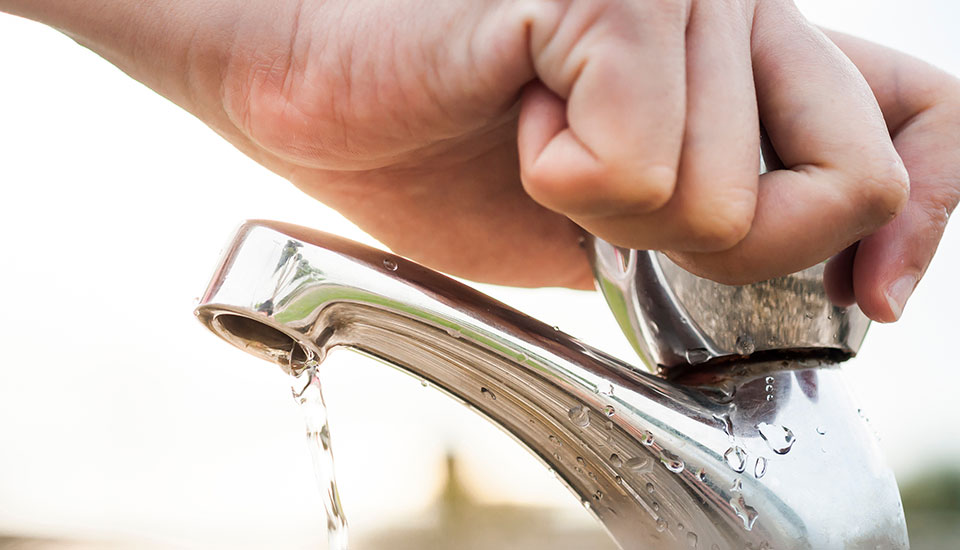
Conserving water is one way to reduce stress and anxiety, says K-State Community Health expert Elaine Johannes.
Aug. 17, 2026
By Pat Melgares, K-State Extension news service
MANHATTAN, Kan. -- Kansas residents who shorten their showers or delay watering the lawn may be protecting more than the state’s water supply. They may also be safeguarding their mental health.
That’s one of the messages from Elaine Johannes, the Kansas Health Foundation’s Distinguished Professor of Community Health at Kansas State University, who says the state’s 40 Gallon Challenge is as much about emotional resilience as it is about water conservation.
The challenge encourages Kansans to save at least 40 gallons of water per day through simple steps at home and in their communities. Johannes said those seemingly small actions can help reduce the chronic stress tied to long-term drought and climate change.
As of Aug. 14, the challenge is being pilot-tested in Ford, Grant, Greeley, Meade, Morton, Stanton, Thomas, Finney, Scott, Haskell, Seward and Stevens counties. Organizers hope to be able to offer the challenge in every Kansas county in 2027.
“When drought becomes long term, that occasional stress can become a chronic anxiety,” Johannes said.
Listen to an interview by Jeff Wichman with Elaine Johannes on the weekly radio program, Sound Living, produced by K-State Extension.
She adds that persistent worry about water -- and the livelihoods that depend on it -- can disrupt sleep, eating habits and even a person’s willingness to stay connected to family and community.
Johannes said research in climate psychology shows people feel deep grief when their familiar landscapes change, a feeling known as solastalgia. Farmers, ranchers and rural residents, in particular, may grieve the loss of the land and water they have depended on for generations.
In western Kansas, where the Ogallala aquifer underpins much of the agricultural economy, that grief can lead to a sense of helplessness.
“The environment has changed,” Johannes said, noting that producers often face reduced productivity not because of poor management, but because water resources are depleted. “When we see no way of changing it, that can really affect our mental health for the long term.”
The 40 Gallon Challenge, she said, offers an antidote rooted in what mental health professionals call meaningful focused coping -- taking actions that are purposeful, shared and aligned with a person’s values.
“Meaningful focused coping means we’re coping, but our actions and our behaviors and our efforts have meaning to them,” Johannes said.
She points to examples such as trimming a couple of minutes off a shower, waiting until the dishwasher is full, or cutting back on lawn watering. When families talk openly about those choices -- and when neighborhoods, 4-H clubs, sports teams or faith communities join in -- the mental health benefit grows.
“Meaningful focused coping is best when you share it, when you talk it up, when you know that your whole neighborhood maybe is involved,” Johannes said. “People will feel like, ‘We can take action. We don’t have to be anxious alone.’”
Johannes credited K-State Extension agent Monica Walker in Grant and her extension colleagues from surrounding counties for bringing the 40 Gallon Challenge into Kansas communities, where it is being used with youth and families to model thoughtful decision-making about water.
Those lessons may be especially important for younger generations, Johannes said. Research indicates that Gen Z (roughly, those born between 1997 and 2012) and other young people report elevated anxiety about climate change and environmental uncertainty.
“Anxiety is not a bad thing,” Johannes said. “It keeps us alert and prepared. But this long, persistent anxiety…we need to give young people ways to respond.”
Programs like the 40 Gallon Challenge can channel that concern into productive action, she said, helping youth become more engaged in community life, from local clubs to city councils and faith groups that work together on community improvement projects.
Ultimately, Johannes ties water conservation and mental health into a broader One Health view, which links human, animal and environmental health.
“When we take a One Health view, we understand then that we are part of the environment, and the environment is part of our livelihoods and part of how we live as a society,” she said. “We can make a difference, as long as we’re working together.”
More information on the 40 Gallon Challenge and other topics is available at local extension offices in Kansas.
***

K‑State Extension is a short name for the Kansas State University Cooperative Extension Service, a program designed to generate and distribute useful knowledge for the wellbeing of Kansans. Supported by county, state, federal and private funds, the program has county extension offices statewide. Its headquarters is on the K‑State campus in Manhattan. For more information, visit www.ksre.ksu.edu. K-State Extension is an equal opportunity provider and employer.